
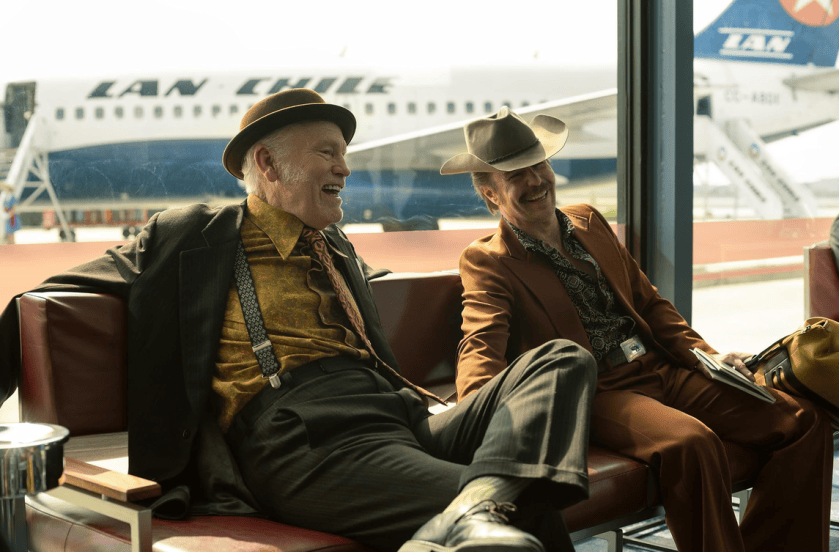
Writer and director Martin McDonagh’s dark comedy “Wild Horse Nine” feels like “In Bruges” and “The Banshees of Inisherin” had a baby that they dropped on Easter Island.
Shortly before the 1973 Chilean coup, CIA agents Chris (John Malkovich) and Lee (Sam Rockwell) are sent from Santiago to Easter Island by their bureau chief, MJ (Steve Buscemi). Amid the island’s iconic statues, the longtime partners confront their troubled pasts and unravel a web of conspiracies. But when Chris forms an unexpected bond with two rebellious students (Mariana Di Girólamo and Ailín Salas), their assignment takes an increasingly dangerous turn that threatens to derail their mission and send their escape to the remote paradise spiraling out of control.
The uneasy friendship between Chris and Lee is the heart of the film, and they are near polar opposites. Chris is an eccentric aging officer who is dying of cancer, and Lee is his younger, foul-mouthed protégé. Malkovich and Rockwell make the perfect screen pair, and both actors are particularly good at playing their characters off each other. Rockwell nails Lee’s swaggering cynicism against Malkovich and his character’s increasingly erratic, philosophical outlook. These are two very strong performances from both men, but they have an equally strong script to work with.
The film is uncomfortably funny in that distinctly McDonagh way. His writing is sharp, profane, politically incorrect, and just a little cruel, and this script offers no tangent from his trademark voice and style. There are stretches when the movie moves effortlessly between hysterical comedy and genuine sadness, a balance McDonagh has mastered before. The laughs give way to something more melancholy as Chris begins confronting his past and the damage he helped cause. His illness gives the story an unexpected tenderness, turning the story into a reflective one about aging, mortality, friendship, and the need to believe your life meant something.
The problem is that the film sometimes feels a little too much like a remix of his earlier work. The dialogue, rhythms, dark humor, and sudden philosophical turns create a strong sense of déjà vu, particularly for anyone who is well-versed in his other films. Parts of the script feel all too familiar, and even the film’s political commentary isn’t very convincing. McDonagh tries to connect the personal reckoning of his characters to the moral rot of American interventionism and the 1973 Chilean coup, but the historical material is tacked onto the story rather than organically developed. And tying a part of the story into a famous U.S. historical event plays like a forced, gimmicky plot device verses a deeper examination of guilt and complicity.
Despite these minor criticisms, “Wild Horse Nine” is a very good film. The writing is strong, the performances are lively, and beneath all profane bickering is a surprisingly tender story about two men confronting the end of one life and the end of a longtime friendship. The film may not break new ground for McDonagh, but when it hits its stride, it’s funny, sad, and unmistakably his.
By: Louisa Moore

