
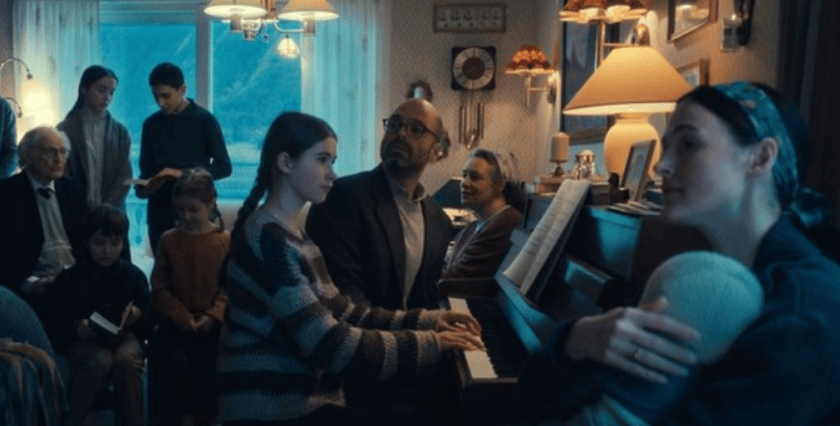
Writer and director Cristian Mungiu‘s tense and morally complicated drama “Fjord” is a story about the collision of deeply held religious beliefs, parental rights, and the authority of the state.
Renate Reinsve and Sebastian Stan star as Lisbet and Mihai Gheorghiu, a conservative Christian couple who relocate from Romania to an isolated Norwegian village with their five children. They gradually become close to their neighbors, and their children form friendships despite growing up in very different households. But the cultural differences become impossible to ignore when one of the Gheorghiu children gets into trouble at school over religious views, and a teacher later notices bruises on another child’s body. What follows is a devastating clash with Norway’s child welfare system that threatens to tear the family apart.
Mungiu doesn’t make it easy to decide where you stand. Mihai is rigid in his beliefs and openly admits to occasionally spanking his children, while Lisbet is more attuned to Norwegian culture and the world around her. Their conviction that they have the right to raise their children according to their faith runs headlong into a system determined to protect those children. The resulting legal and bureaucratic battle raises uncomfortable questions about where parental authority ends and a child’s right to protection begins. It’s a fascinating conflict, particularly because neither side is presented in entirely black-and-white terms.
Stan and Reinsve are terrific, bringing a grounded, convincing chemistry to two people whose marriage and beliefs are tested under extraordinary pressure. They’re not always particularly likable, but it’s difficult not to sympathize with their desperation as the situation spirals out of their control. The film maintains a tension that’s heightened by the stark, icy Norwegian landscape. The bureaucracy feels just as cold and unforgiving as the surroundings, with little room for cultural nuance or individual circumstances.
My biggest reservation is that the film focuses so heavily on the parents’ ordeal that the children, whose welfare is supposedly at the center of everything, often feel pushed to the margins. Their perspectives and experiences deserve more attention, but the issues presented in the film becomes even more complex by this decision to keep audiences in the dark. Mungiu’s refusal to offer easy answers makes his film a compelling conversation starter, even if some of his choices are frustrating.
The ending takes an unexpected turn into magical realism, and I suspect audiences will have very different interpretations of its meaning. For me, the final image is a beautiful expression of love as something that transcends religion, borders, and the rules imposed by adults. In a film so consumed by competing ideologies and institutional power, that small moment of unconditional love feels especially moving.
“Fjord” seems by design to divide audiences, but it’s absolutely guaranteed to spark heavy debate.
By: Louisa Moore

