
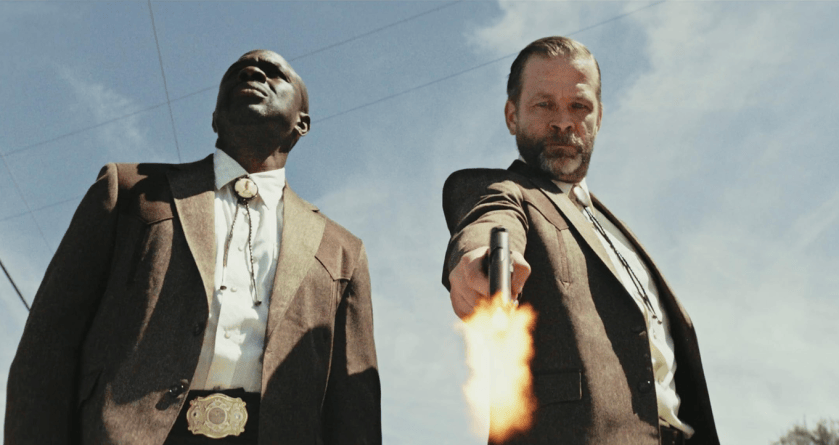
The wonderfully grimy and melancholy “American Muscle” is a slow burn crime drama that feels like it wandered into the desert after taking a wrong turn somewhere between “Badlands” and “No Country for Old Men.” Writer and director Joel Veach gives the film a distinct Midwestern gothic sensibility set against the parched landscape of California’s Death Valley, using stark lighting, a mournful score, and deliberate pacing to create a world where trouble feels inevitable.
David Thompson plays Ray, a desperate mechanic saddled with a $100,000 gambling debt after his father’s death. He’s counting on the life insurance money to get himself out of trouble, but bureaucracy moves at a frustratingly human pace. The two debt collectors (Brendan Sexton III and Gbenga Akinnagbe) waiting for their money have considerably less patience of course. Things get worse when Ray’s estranged sister Maggie (Liana Wright-Mark) comes home and the collectors take her hostage, forcing him to decide just how far he’s willing to go to save her.
What makes the movie work is that Veach isn’t interested in turning this into a nonstop shootout. The tension comes from conversations, silences, strange detours, and the growing sense that Ray is trapped in a cycle of bad choices. There’s a clear Tarantino influence in the sharp dialogue and dark humor, but the film has enough of its own personality to avoid feeling like a lazy copycat. The deliberate pacing gives the characters room to breathe, and that makes the violence feel considerably more unsettling when it finally arrives.
Thompson and Wright-Mark are particularly good as Ray and Maggie. Their relationship feels lived in with the kind of complicated shorthand that comes from siblings who share a history they’d probably rather forget. Their shared childhood trauma hangs over every interaction, giving the story some real substance that elevates it beyond a conventional crime thriller.
Then there are Sexton III and Akinnagbe, who are easily the movie’s most entertaining surprise. Rather than playing debt collectors One and Two as generic heavies, Veach gives them philosophical streaks, a sense of humor, and a developed moral code. Sexton and Akinnagbe have terrific chemistry, turning their drawn out conversations into some of the film’s best and most memorable moments. They can be menacing one moment and funny the next.
The film also has more on its mind than simply whether Ray will survive. Questions of fate, morality, determinism, and familial sacrifice run underneath the story. A visit to a tarot card reader adds another layer to the idea that perhaps these characters are destined to repeat their mistakes. Ray spends much of the movie trying to outrun the consequences of his past, only to discover that escaping yourself is considerably harder than escaping a debt.
For an independent film made on a modest budget, “American Muscle” looks remarkably confident. It has a glossy neo-noir surface without losing the rough edges that give this indie crime movie its character. More important, it trusts its dialogue and performances rather than constantly reaching for bigger and louder moments. The result is a stylish dark action comedy that’s surprisingly affecting.
By: Louisa Moore

