
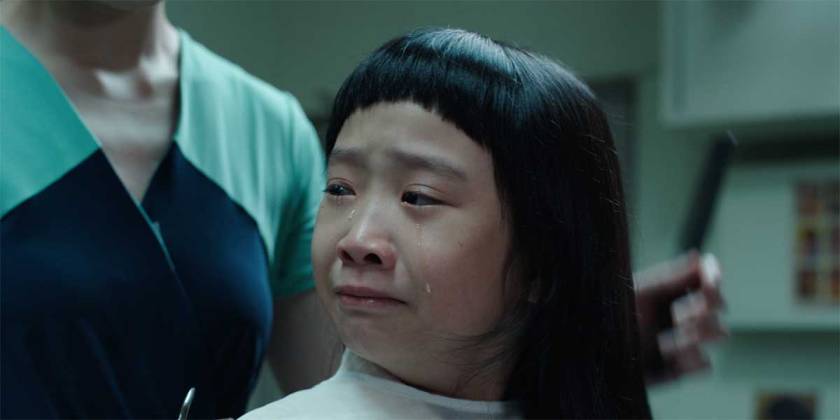
Writer and director Geck Geck Priscilla Ang’s “Ah Girl” starts a little slow, but once it finds its rhythm, it becomes a really touching and heartbreaking film.
Set in 1994 Singapore, the story follows seven year old Ah Girl (Ong Xuan Jing), a curious, cheeky kid who spends her days drawing, catching spiders, arguing with her younger sister, selling chewing gum at school, and trying to imitate the adults around her. More than anything, she just wants to grow up. As most of us did when we were kids, she thinks being older means finally getting to make her own decisions.
But Ah Girl is forced to grow up much sooner than she should.
Her parents are separated, her father works nights, her grandmother is difficult, and her mother comes and goes, trying to make up for her absence with gifts and treats. Meanwhile, Ah Girl has to look after her younger sister and deal with the constant back-and-forth between her parents. What makes it especially sad is that the adults are so caught up in their own problems that they don’t always realize how much their children are affected.
That’s what I liked most about the film. It doesn’t turn the adults into villains or make the children unrealistically wise. Instead, we see everything from Ah Girl’s perspective, where adult behavior can seem completely ridiculous and confusing. She doesn’t fully understand what’s happening, but she feels the consequences of it.
The two young actors are excellent, especially when the film becomes more painful. Their performances make the impact of the parents’ separation feel very real. There are moments that are funny and playful, but underneath all of that is a child slowly realizing that the world isn’t as safe or simple as she thought it was. Some of those scenes genuinely broke my heart.
Visually, the film has a lovely nostalgic quality. The soft cinematography, everyday details and playful dreamlike moments make 1990s Singapore feel like a childhood memory rather than just a setting. It has that slightly hazy, imperfect feeling of looking through an old home video, which fits the story beautifully.
You can also feel how personal the film is. Inspired by the director’s own childhood, it doesn’t feel like it’s trying too hard to manufacture nostalgia. The little, relateable things like school, siblings fighting, silly crushes, family arguments, and wanting to be treated like a grown up are what make it hit home.
It’s a bittersweet and sad story, but not a hopeless one. More than anything, “Ah Girl” feels like a reminder that children notice far more than adults think they do. And it’s the kids who are forced to grow up too soon that are the ones who teach us the most about resilience.
By: Louisa Moore

