
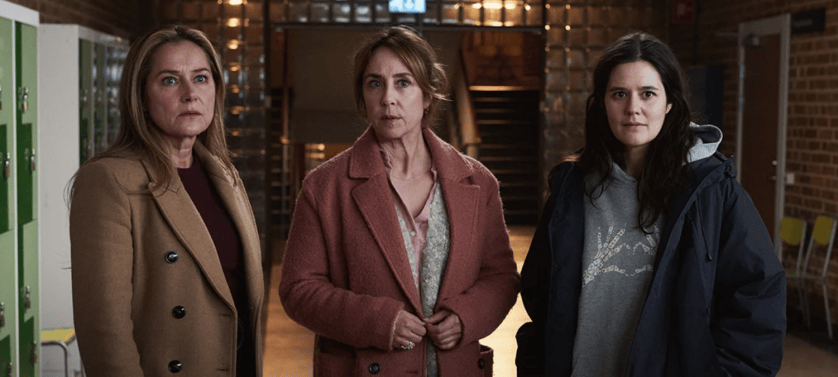
Director Amalie Næsby Fick’s drama “What Lies Between Us” constantly makes you reconsider who you’re rooting for from one scene to the next. The film looks like a comfortable picture of friendship and family life before everything is dismantled into a million pieces. This is a story about the lengths people will go to protect their children, even when protection starts to look a lot like complicity.
In an affluent Danish suburb, realtor Anne Sofie (Sidse Babett Knudsen) and shop owner Sara (Sofie Gråbøl) are close friends whose lives are deeply intertwined. Their sons are part of the same tennis club where Ulrikke (Asta Kamma August), a single mother and newcomer to the community, is trying to find her place. That fragile social equilibrium collapses when an allegation of sexual assault involving the boys surfaces. Almost immediately, friendships become alliances, suspicion takes over, and everyone seems to have their own version of what happened.
What makes the film so compelling is that it doesn’t rush to tell us whom to believe. Fick and screenwriters Sara Jønsson and Nikolaj Arcel build the story around uncertainty, allowing doubt to accumulate rather than handing the audience easy answers. Even the women at the center of the narrative are difficult to categorize. At first, Anne Sofie, Sara, and Ulrikke are remarkably easy to like. They’re supportive friends and devoted mothers, the sort of people you could imagine wanting to spend time with. That familiarity makes the choices that follow all the more unsettling.
Knudsen is particularly good as Anne Sofie, bringing intelligence and force to a woman whose instinct to protect her son gradually pushes her toward a moral breaking point. Gråbøl and August are just as strong, and the young actors handle material that asks a great deal of them. These aren’t characters neatly divided into good and bad. They are parents convinced, sometimes desperately, that they are doing what they have to do. The film’s tension comes from watching that conviction collide with consequences.
There’s also a sharp critique of privilege running underneath the personal drama. These are people with money, connections, and social standing, and those things become another form of protection. The community has every incentive to preserve its comfortable image, even if doing so means ignoring uncomfortable truths. The film understands that silence doesn’t always require an explicit conspiracy. Sometimes people simply decide there are things they would rather not see.
That makes the film especially uncomfortable. It asks where the line is between protecting your child and protecting them from accountability, and whether love can become destructive when it is allowed to override every other moral obligation. The fathers are largely absent from this equation, leaving the story to focus on women navigating the complicated territory of motherhood, loyalty, and the emerging masculinity of their sons.
Fick handles the material like an emotional thriller, steadily tightening the screws while keeping the truth just out of reach. The ambiguity works because it isn’t merely a gimmick, but it forces the audience to sit with how quickly accusations can destroy relationships and reputations (regardless of what the eventual truth turns out to be). When that truth finally arrives, the film doesn’t hide behind an ambiguous ending. Instead, the revelation casts what came before in a different light, making earlier choices both more understandable and more disturbing.
“What Lies Between Us” is not an easy film to watch, particularly as the story moves into very dark territory. It refuses the reassuring idea that morality becomes simple when the stakes are personal. Sometimes the hardest questions begin with the most understandable impulse of all, wanting to protect your child and family. The frightening part is discovering what you’re willing to sacrifice to do it.
By: Louisa Moore


Nope. Not going to see that one.
LikeLike