
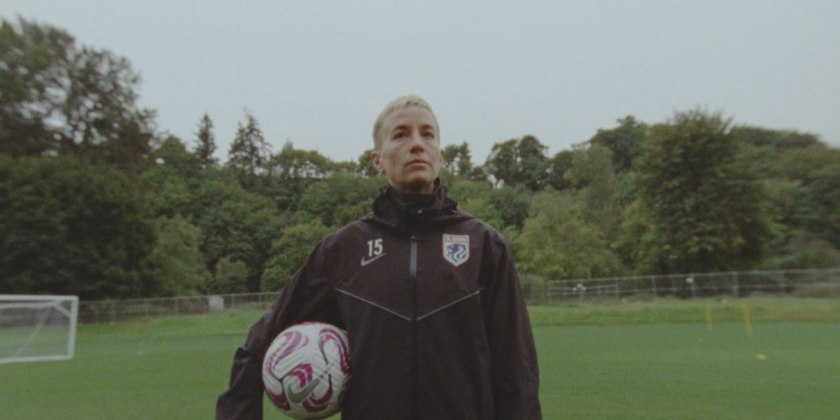
“Rapinoe” could have been a straightforward sports documentary about a great athlete, big career, major wins, and an inspiring legacy. Instead, director Rebeca Huntt turns her film into something much more interesting. This is a deeply personal psychological portrait of soccer superstar Megan Rapinoe and the price of becoming someone who refuses to stay quiet.
Rapinoe’s career gives the film plenty to work with. She was a key player on U.S. teams that won two World Cups and an Olympic gold medal, and her creativity and playmaking helped define the modern era of women’s soccer. But the film is less interested in replaying her greatest goals than in understanding the person behind them, and that choice makes all the difference.
Rather than glossing over the consequences of Rapinoe’s outspoken activism, the documentary goes straight into the backlash. She became the first prominent white athlete to kneel in solidarity with Colin Kaepernick, and what followed was ugly. Rapinoe faced intense criticism, death threats, political attacks, and periods of real isolation. The film doesn’t treat those experiences as a footnote to her career because they are central to understanding her as a human.
What I found most fascinating is the way Rapinoe learned to survive that pressure psychologically. She talks about compartmentalizing and at times disconnecting from what was happening around her. Imagine walking onto a soccer field while an entire stadium is booing you and somehow turning all of that noise into a laser focus. For Rapinoe, that mental armor became part of her competitive drive. The same stubbornness that helped her withstand public attacks also helped make her such a formidable player.
The film is also unusually good at letting Rapinoe simply be herself. She’s disciplined, outspoken, funny, stubborn, and completely unapologetic about what she believes. Whether she’s talking about LGBTQ+ rights, equal pay, or transgender inclusion in sports, there’s no attempt to soften her opinions for the audience. You don’t have to agree with her on everything to understand why she has become such a compelling figure.
That sense of intimacy comes partly from Huntt’s approach, which feels very different from a typical polished, formulaic sports biography. This is a film where the subject is allowed a period of self reflection. At one point, Rapinoe lies on a couch as though she’s in therapy. It’s playful, but there’s something revealing about the image. As her playing career comes to an end, she is finally forced to sit with the person she has become.
Rapinoe grew up in a small, conservative town in a large working-class family marked by both love and turmoil. She came out as queer in an environment that gave her plenty of reasons to remain closeted. She then became part of a generation of women athletes who transformed the visibility of their sport, before taking on the fight for equal pay and pushing that issue into the global spotlight.
But this film isn’t really about checking off those milestones. It’s about what they cost her.
The film captures someone wrestling with the difference between winning and actually feeling at peace. Rapinoe has spent much of her life measuring success through trophies, goals, championships, and battles won. Now she has to consider other kinds of victories like repairing relationships, understanding her family, accepting parts of herself, and figuring out who she is when there is no longer a game waiting for her.
By the end, Rapinoe feels less like a distant sports celebrity and more like someone you’ve spent a few very honest hours getting to know. You see her enviable confidence, but you also see the fear, anger, loneliness, humor, and vulnerability underneath it.
Even if you know little about Megan Rapinoe or have no particular interest in soccer, “Rapinoe” has a lot to offer. This isn’t simply a story about an athlete who won a lot, but a portrait of someone who decided that being a champion meant using her voice, accepting the consequences, and refusing to apologize for what she believes.
By: Louisa Moore

