
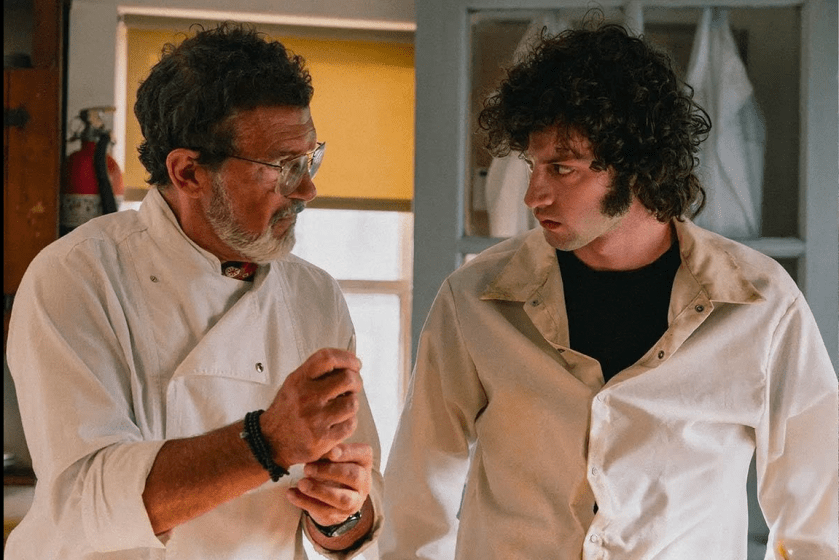
Most biopics try to explain a life by cramming decades into two hours, but “Tony” wisely goes in the opposite direction. Rather than racing through chef, traveler, and food personality Anthony Bourdain’s greatest hits, director Matt Johnson focuses on one transformative summer in 1975 when a reckless, privileged 19-year-old stumbled into a Provincetown restaurant kitchen and unknowingly found the path that would define the rest of his life.
Adapted from an early chapter of Bourdain’s memoir “Kitchen Confidential,” the film wastes little time establishing who Tony (Dominic Sessa) is before the kitchen changes him. A quote from the book introduces him as “spoiled, miserable, narcissistic, and self-destructive,” and the description fits. After bombing out at Vassar College, lying to his parents about a prestigious writing fellowship, and stealing his father’s wallet to escape the fallout, Tony arrives in Provincetown, Massachusetts with nowhere to go and no real plan. A failed attempt to reconnect with his high school crush (Emilia Jones) leaves him broke and stranded until an intimidating executive chef (Antonio Banderas) gives him a job washing dishes.
Sessa delivers another terrific performance, capturing both Tony’s unbearable arrogance and the insecurity buried beneath it. He never asks the audience to like Bourdain, only to understand him. The film refuses to sand away its subject’s rough edges, presenting him as an immature hothead whose oversized ego is really a carefully constructed shield against failure and self doubt. Watching that false persona slowly crack is far more compelling than the usual rise-to-success montage.
Johnson brings a tactile authenticity to the restaurant world. The kitchen isn’t glamorous, nor is it especially interested in celebrating food itself. This is a movie about the people doing the work, the dishwashers, prep cooks, and line cooks who endure relentless heat, impossible pressure, and brutal hierarchy to keep a well-oiled engine humming. The kitchen becomes a refuge for society’s outsiders, a place where discipline, respect, and shared suffering forge an unlikely sense of belonging. Anyone who has worked in a restaurant will immediately recognize the pirate-like camaraderie that develops in those cramped and chaotic spaces.
There’s also this sense of melancholy that hangs in the air. Provincetown is bathed in nostalgic summer sunlight, yet an undercurrent of sadness drifts through nearly every scene. Johnson constantly contrasts the freedom of a seaside summer with the harsh realities of adulthood, hard labor, and the search for identity. It’s appropriately moody and reflective in tone.
The film also explores larger ideas without forcing them. It examines how people invent public versions of themselves to hide private insecurity, how failure can become a turning point, and how a single moment in time can quietly redirect an entire life. These themes give the story a weight that extends beyond its biographical framework.
The film’s narrow focus does come with limitations. By confining the story to one summer, the story avoids the checklist approach that bogs down so many biopics. At the same time, that limited scope creates stretches that feel slow and occasionally repetitive, with the rhythms of kitchen life beginning to blur together. This one requires some patience as well as reflection.
Fans expecting a celebration of food or a chronicle of Bourdain’s celebrity years may come away surprised, as Johnson’s film has remarkably little interest in culinary artistry. Instead, it’s about the people behind the swinging kitchen doors and the dreams of the workers whose sweat, mistakes, and perseverance keep restaurants alive. In that sense, the film feels less like a portrait of a future icon than a love letter to the industry that shaped him.
“Tony” is an unconventional biopic, but that’s exactly what makes it memorable. Rather than trying to explain Anthony Bourdain’s entire life, it captures the messy, uncertain moment when it first began to make sense.
By: Louisa Moore

