
“The End of Oak Street” feels like the kind of movie I would have stumbled across in the 1980s when I was way too young to be watching it, only to spend the next several nights lying awake and regretting my life choices.
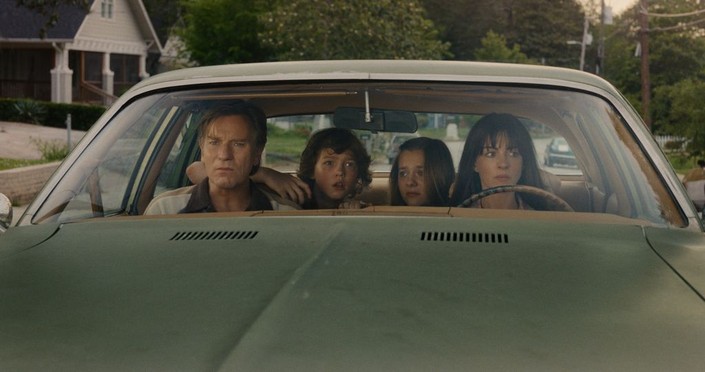
Writer and director David Robert Mitchell’s delightfully retro sci-fi survival horror film begins with an unmistakably Spielbergian suburban block party in 1982. The Platt family, mom Denise (Anne Hathaway), dad Greg (Ewan McGregor), and their teenagers Audrey (Maisy Stella) and Brian (Christian Convery) are dealing with the usual suburban problems: marital distance, teenage resentment, buried secrets, and the creeping realization that the picture-perfect family life they’re presenting to the world isn’t particularly perfect.
Then their entire neighborhood gets dropped 150 million years into the past.
The movie makes a surprisingly sharp turn from nostalgic suburban drama into prehistoric survival horror. Suddenly, the biggest problem on Oak Street isn’t a troubled marriage or an unhappy teenager, but it’s the man-eating dinosaurs. Theropods stalk the neighborhood and rip apart residents and their pets, winged reptiles swoop overhead to terrorize, and eventually there’s even a T. Rex who attacks anyone who stands in his way.
There’s plenty of dinosaur action, but Mitchell is less interested in making another creature feature than in using the apocalypse to strip away the family’s suburban façade. All those little grievances and secrets that seemed so important before become meaningless when survival is suddenly the only thing that matters. The family has to figure out how to actually depend on one another rather than simply occupy the same house. It’s a pretty dark idea hiding inside what initially looks like a nostalgic adventure movie.
The film is very much an ’80s movie in spirit. Mitchell captures the look, rhythm and atmosphere of the era without simply turning the film into a collection of references. There’s something wonderfully old fashioned about the setup, the suburban setting, and the sense of wide-eyed adventure before everything becomes much nastier.
Unfortunately, the dinosaurs themselves aren’t always convincing. Some of the visual effects look surprisingly cheap, and there are moments when the prehistoric creatures look more like effects from a low budget television production than a big screen creature feature. It’s distracting, particularly when the movie is asking you to be terrified of something that looks so fake.
Fortunately, the cast sells it.
Hathaway and McGregor work hard to bring an authentic energy to the Platts, which means the family drama never feels like filler between dinosaur attacks. Stella and Convery are equally good, and the actors seem to understand that the movie works best when the spectacle is grounded in the family’s increasingly desperate situation.
Mitchell also isn’t afraid to push the PG-13 rating, either. This film gets surprisingly brutal, with the violence occasionally feeling like it’s leaning over the R-rated line and wondering whether anyone is going to stop it. That’s another reason the movie feels like something I might have seen as a kid and absolutely should not have been watching.
The biggest surprise is how strange the movie becomes by the end. The story raises considerably more questions than it answers, culminating in a mind bending final stretch that gives the whole story a darker, more existential dimension. I’m glad Mitchell doesn’t feel obligated to explain everything, and the ending is unsettling precisely because the implications are left hanging in the air.
Underneath all the dinosaurs, the movie is really about the end of the illusion of control. Take away the house, the neighborhood, the routines and the comfortable suburban mythology, and what’s left? A family that has to decide whether it actually knows how to be a family.
“The End of Oak Street” is a solid summer movie. It’s nostalgic, creepy, surprisingly cynical, and occasionally brutal. The effects may not always live up to the ambition, but the movie’s heart, atmosphere, and wonderfully nasty streak work extremely well together.
By: Louisa Moore

