
Crime thrillers often rely on familiar formulas, but “Gangland” distinguishes itself by using its neo-Western crime framework to explore something deeper. Director Vincent Grashaw crafts a thoughtful, atmospheric character study that examines trauma, accountability, and the challenges facing Indigenous communities, while still delivering an engaging mystery filled with tension and danger.
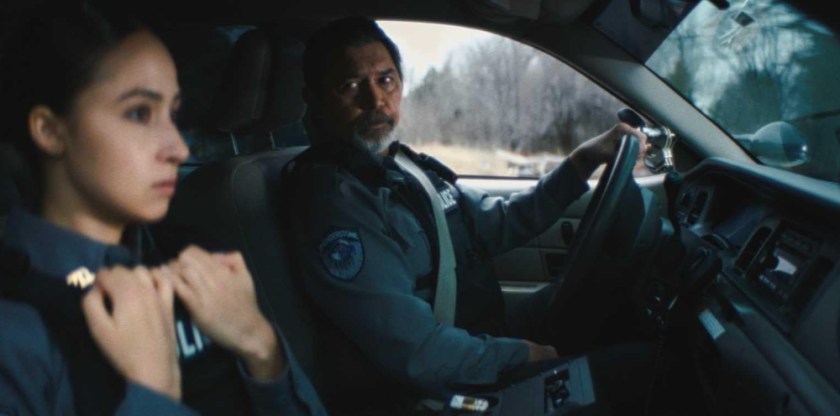
Lou Diamond Phillips delivers one of the strongest performances of his career as Teddy Sharpe, a veteran officer with the Thunderstone Tribal Police Department. Dedicated to protecting his community but haunted by a past mistake that continues to weigh heavily on him, Teddy is tasked with mentoring a new recruit, the by-the-book trainee Sandra (Dana Namerode). Their partnership is tested when a recently released fugitive returns to the reservation, leaving a trail of gangland murders in his wake and threatening to ignite a violent conflict.
The crime investigation does more than just present a simple battle between good and evil, exploring how poverty, addiction, systemic neglect, and generational trauma contribute to cycles of violence. One particularly powerful monologue from Teddy about how “broken boys become broken men” encapsulates the film’s central thesis. The gang activity depicted here is not portrayed as glamorous criminality but as a symptom of deeper social wounds that have been allowed to fester for generations.
Grashaw wisely avoids slick action movie clichés that often dominate the genre, instead embracing a gritty realism that makes every confrontation feel authentic and consequential. The reservation setting becomes a character in its own right, with the film capturing both its beauty and its struggles. The day-to-day realities of tribal policing are portrayed with refreshing honesty, emphasizing jurisdictional challenges and the difficult balance between protecting a community and respecting its complex internal dynamics.
The screenplay also benefits from its refusal to offer easy answers. Nearly every morally complex character exists in shades of gray, motivated by survival, guilt, loyalty, or desperation. Community members often withhold information from outsiders in an effort to protect one another, yet that same silence allows exploitation, criminal activity, and unresolved trauma to continue unchecked.
Perhaps most impressive is the film’s commitment to authenticity. By casting numerous Indigenous actors and treating Native culture with respect and nuance, the film avoids the stereotypes that have too often plagued stories set on reservations. The result is a film that feels lived-in and sincere, offering representation that serves the story rather than functioning as a superficial backdrop.
While the film’s deliberate pacing may not satisfy viewers looking for constant action, the slow-burn approach ultimately pays off. Grashaw steadily builds tension through strong writing, layered characters, and an ever-present sense of unease. The mystery remains compelling throughout, but the emotional journey of Teddy (including his struggle with guilt, redemption, and personal responsibility) is what gives the film its lasting impact.
“Gangland” succeeds because it transforms a familiar crime thriller into a culturally respectful and emotionally resonant examination of community, trauma, and accountability. Enriched by its authentic perspective, the film offers a gripping story while shedding light on issues that are rarely explored with such honesty.
By: Louisa Moore

