
Pixar returns to one of its most beloved franchises with “Toy Story 5,” a sequel that swaps cowboys and space rangers for a debate many families are already having: can imaginative play still compete with technology?
Bonnie’s beloved toys find themselves facing an unfamiliar rival in Lilypad (voiced by Greta Lee), a new tablet designed to entertain, educate, and replace traditional play. As Woody (Tom Hanks), Buzz Lightyear (Tim Allen), Jessie (Joan Cusack), and the rest of the gang struggle to find their place in Bonnie’s changing world, the film explores how childhood has evolved in the digital age without losing sight of what made the series so special in the first place.
This isn’t the most inventive chapter in the franchise. The story feels all too familiar, with a central conflict that’s doesn’t offer any surprises. Some of the film’s biggest ideas, like the effects of screen addiction, online bullying, and the changing nature of childhood friendships, are introduced with genuine thoughtfulness but ultimately wrapped up a little too neatly. A debate this complex deserves a messier, more challenging resolution than the film is willing to provide. Then again, it’s an animated filmed aimed at families with kids, so sometimes simple makes for a better crowd-pleaser.
Even so, the story has an emotional intelligence that carries it through the weaker moments. Rather than treating technology as the villain, the film acknowledges both its benefits and its drawbacks. The film argues for finding balance, reminding audiences that tablets and digital learning have their place but should never replace imagination, friendship, or genuine human connection. It’s a timely message delivered with warmth instead of judgment, and it will hopefully inspire a lot of parents and kids to put down their devices (at least for a little while).
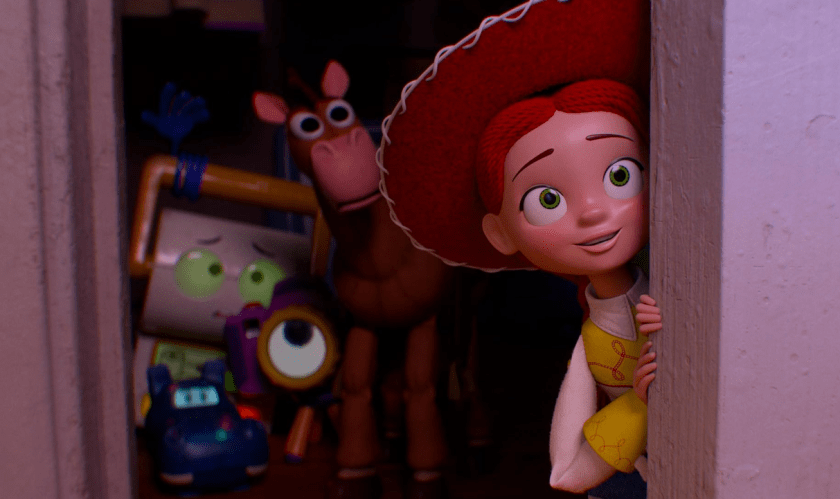
Jessie emerges as the heart of the story, and Joan Cusack gives one of her strongest performances in the series. Now serving as Bonnie’s sheriff, Jessie leads with courage, empathy, and determination, often putting others before herself while learning to work alongside technology rather than simply resisting it. She’s a terrific role model, demonstrating resilience, compassion, and leadership without ever losing the vulnerability that has always made her such a lovable character. It’s refreshing to see the spotlight shift in her direction, particularly in a franchise that has traditionally revolved around Woody and Buzz.
The supporting cast of toys continues to embody the values that have always defined these films, and the story leans heavily into the importance of loyalty, teamwork, generosity, and perseverance. Toys don’t lose their value simply because children grow up. Even if they’re eventually placed on a shelf, packed into a box in the garage, or sent off to a donation center, they remain meaningful because of the comfort, joy, and memories they once provided. Growing up is inevitable, but those connections never truly disappear.
That’s where the nostalgia gets heavy, especially for those of us who remember a childhood before electronic devices took over. Watching Bonnie’s toys struggle against the lure of screens brought back memories of afternoons spent inventing stories with action figures, stuffed animals, and whatever else happened to be lying around my bedroom floor. It’s difficult not to wonder how different that experience is for children growing up today, surrounded by electronics competing for their attention. The movie never suggests that technology is inherently bad, but it makes a persuasive case that something valuable is lost when imagination takes a back seat.
Visually, Pixar remains in a class of its own. The animation is wonderful from beginning to end, and the creative team has once again crafted a movie where fantasy and reality blend so seamlessly that it’s easy to forget you’re watching an animated film. Every texture, expression, and movement feels remarkably lifelike, making this one of the studio’s most impressive technical achievements. It looks great from start to finish.
Since this is the fifth film in the series, the very real feeling of franchise fatigue has begun to settle in. Most audiences probably won’t remember what this film was about because the common (repetitive) themes blend in with all of the previous films. Still, spending time with these characters feels like catching up with old friends. Their chemistry remains effortless and the emotional moments continue to resonate.
“Toy Story 5” may not reach the heights of Pixar’s finest installments, but it delivers an engaging, family-friendly adventure with plenty of heart, timely themes, and breathtaking animation.
By: Louisa Moore

