
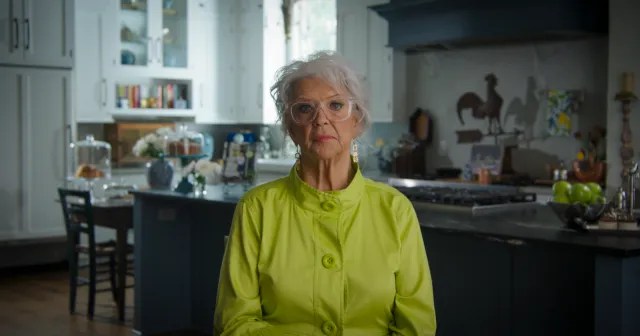
A documentary with an important premise but glaring omissions, “Canceled: The Paula Deen Story” fails to confront the full reality of its subject’s downfall. Instead of a thoughtful reckoning that explores the trial of public opinion in the age of cancel culture, director Billy Corben decides to reframe the narrative in a selective retelling that glosses over critical context in favor of a more sanitized, sympathetic portrait of his subject. As such, the documentary seems designed more to rehabilitate Deen’s public image than to honestly examine the scandal that ended her career.
The film traces Paula Deen’s meteoric rise from a struggling single mother running a Savannah restaurant to a national culinary icon. Best known for her Southern charm, butter-laden recipes, and easy rapport with audiences, Deen had a dramatic ascent to fame in the early 2000s. She was featured alongside Oprah, bolstered by bestselling cookbooks, and was the star of multiple Food Network shows. But it’s her 2013 fall from grace that gives the documentary its title and its dramatic arc.
That arc, however, is misleadingly narrow.
The film focuses almost exclusively on the now-infamous deposition in which Deen, when asked if she had ever used a racial slur, replied “Yes, of course.”
The backlash was immediate and severe. Major sponsors dropped her, lucrative television deals vanished, and her multi-million dollar empire crumbled. Corben frames this as an overreaction driven by media sensationalism and the volatility of online discourse. He pulls in extensive interviews with Deen, her sons Jamie and Bobby, and her longtime producer Gordon Elliott, all of whom offer tearful, regretful, and often defensive reflections.
What’s maddening (and in my opinion, irresponsible) is what the documentary leaves out.
There’s no mention of Deen’s admitted desire to host a “Southern plantation-style wedding” with Black waiters dressed as antebellum slaves, a detail revealed in the same deposition that sparked the scandal. There’s also no reference to the 2015 photo she posted of her adult son in brownface dressed as Ricky Ricardo, a deeply offensive image that surfaced two years after her public apology.
These omissions are not minor, they are fundamental to understanding why the backlash wasn’t simply about a single slur but a pattern of questionable behavior and racial insensitivity.
Instead, the film constructs a narrative in which Deen is portrayed as a casualty of a culture too eager to destroy its heroes, a victim rather than a public figure accountable for her own words and actions. While the documentary does feature a few voices that offer more nuanced perspectives (like culinary historian Michael Twitty), these moments feel like brief footnotes in what is otherwise a heavily skewed, image-rehabilitating exercise.
Instead of investigating what Deen’s case says about race, power, privilege, and the American obsession with celebrity redemption, Corben offers a shallow, revisionist take that minimizes the very issues he claims to explore.
Yes, public opinion can be swift and unforgiving. Yes, “cancel culture” deserves interrogation. But when a documentary purporting to explore those themes omits the most damning and relevant facts, it ceases to be a work of journalism and becomes something much more troubling. “Canceled: The Paula Deen Story” is nothing more than a soft focus public relations campaign masquerading as truth telling.
By: Louisa Moore

