
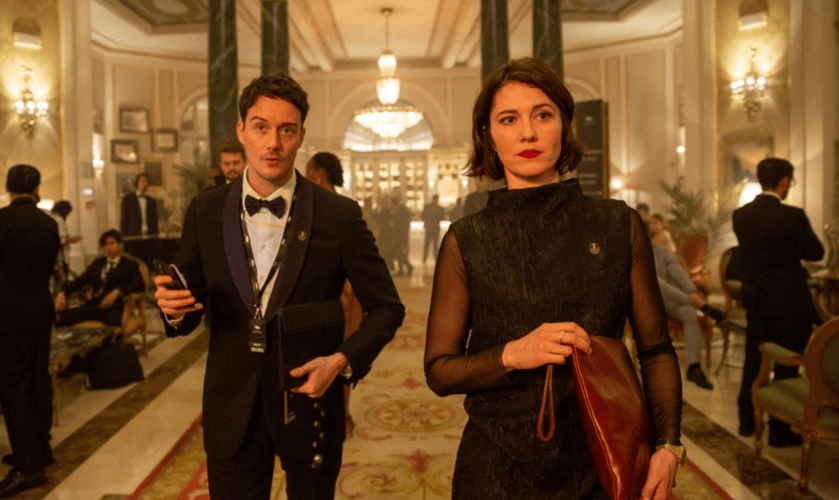
“Rich Flu” arrives with a fascinating high concept premise where a mysterious virus begins killing the world’s wealthiest people, turning money from society’s greatest privilege into a certain death sentence. Watching billionaires frantically try to unload fortunes, destroy assets, and escape their own wealth is undeniably entertaining at first. Unfortunately, this sharp setup for social satire collapses under the weight of clunky execution, heavy-handed messaging, and increasingly implausible storytelling.
The film wants to function as both a dystopian thriller and a biting critique of capitalism, greed, and inequality, but it never successfully balances those competing ambitions. Director Galder Gaztelu-Urrutia repeatedly prioritizes his message over compelling characters or coherent storytelling. Like the similar-minded “Don’t Look Up,” the film often feels more interested in lecturing the audience than engaging them, hammering home its themes with all the subtlety of a sledgehammer.
The biggest problem is that the central premise requires an enormous suspension of disbelief. The idea that a virus can somehow identify the world’s wealthiest individuals is already a stretch, but the suggestion that it can instantly recognize when assets are transferred, abandoned, or destroyed pushes the concept into outright absurdity. The movie asks viewers to accept these rules without question and the longer it goes on, the harder that becomes.
Mary Elizabeth Winstead does what she can with the material, delivering a committed performance as Laura, a billionaire executive desperately trying to save her family. The problem is that Laura is an incredibly difficult protagonist to invest in. She’s narcissistic, privileged, and largely unlikable, making it hard to feel much sympathy for her problem. The film populates its world with wealthy characters who are so greedy and shallow that their suffering rarely generates the emotional response the filmmakers seem to be aiming for. I was never given any reason to care about these rich jerks.
As the story progresses, it eventually spirals into a convoluted refugee crisis subplot that feels disconnected from the stronger ideas introduced earlier. The film asks thought-provoking questions about whether greed is an unavoidable part of human nature and whether genuine altruism can exist in a collapsing society, but it never develops those ideas beyond surface level lip service.
Adding to the problem are several unintentionally hilarious moments that completely undermine the film’s serious tone. Victims of the virus develop impossibly bright white teeth, a visual cue so ridiculous that it borders on parody yet the film presents it with complete sincerity. Between the teeth, the dog that’s hit by an airplane (yes, really), and several other baffling creative choices, the movie is frequently hysterical for all the wrong reasons.
It’s frustrating because there’s a genuinely clever movie buried somewhere inside this premise. The opening act, which watches the ultra-rich desperately panic as wealth suddenly becomes toxic, is darkly funny and full of potential. But as the story grows more convoluted and the satire more self important, that promise evaporates.
A dark, cynical critique of capitalism and wealth inequality, “Rich Flu” clearly has ambitious ideas on its mind. Unfortunately, its shallow social commentary, implausible world building, and unlikable characters prevent those ideas from ever coming together. Despite a committed performance from Winstead and a concept ripe with possibilities, this strange, uneven satire is a real dud.
By: Louisa Moore

