
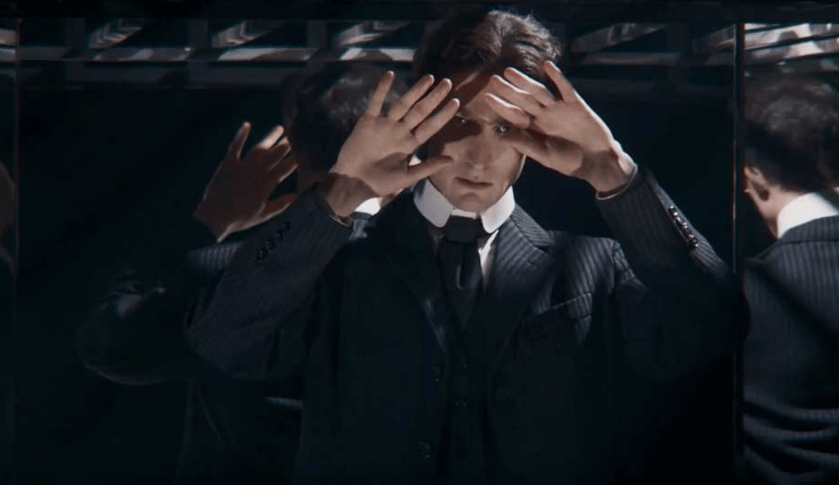
Director Agnieszka Holland’s “Franz” seems determined to to resist the conventions of the traditional biopic genre. Instead of marching dutifully from Kafka’s birth to his death, Holland approaches his life as a kaleidoscope, jumping between time periods, reality and fantasy, Kafka’s private struggles, and the strange afterlife of his name. It’s ambitious and fascinating, yet sometimes a little too clever for its own good.
Idan Weiss is terrific as Kafka, playing him not as the perpetually tortured literary icon we’ve turned him into, but as an actual person who is relatable. We see Kafka as a young lawyer working in insurance and wrestling with the crushing dullness of his day job while trying to protect the writer inside him. He jokes with his sisters, falls in love, worries about disappointing his parents, and occasionally just enjoys being alive. Those lighter moments matter because they make the darkness feel so powerful.
Holland, who has long cited Kafka as an influence, is clearly less interested in explaining the writer than in getting inside the contradictions that made him so compelling. Franz’s relationship with his domineering father becomes particularly important, especially because that deep insecurity and fear of failure didn’t appear out of nowhere. The film makes a persuasive connection between emotional damage and the peculiar, nightmarish worlds he created on the page.
Holland’s most inspired idea may be her decision to drag Kafka into the present. The story repeatedly jumps forward to contemporary Prague, a place where Kafka has now become a tourist industry. His face and name are slapped onto souvenirs, hamburgers, museum exhibits and anything else that can be sold. There’s something wonderfully Kafkaesque about a writer who spent his life skewering bureaucracy and alienation being transformed into a commercial brand, and the film lends a smart commentary to that undeniable irony.
The film also finds a grim angle in looking beyond Kafka’s relatively short life. He died in 1924, never knowing what was coming. The film flashes forward toward the horrors of World War II and the fate of his sisters under the Nazis. Those moments give the movie a chilling sense of historical hindsight. While Kafka’s world was already full of anxiety and dread, history would eventually make his nightmares look prophetic.
Visually, Holland is having a blast. A rapidly panning camera during a tense family dinner turns an ordinary conversation into something resembling a nervous breakdown. Actors occasionally break the fourth wall to address the camera or step outside the period setting and into the machinery of the film itself (which doesn’t work quite as well).
And that’s ultimately my biggest reservation with the film. There’s a lot going on here (maybe too much), with a barrage of fantasy sequences, historical drama, contemporary satire, family psychology, World War II flash forwards, office drudgery and fourth wall breaking experimentation all competing for attention. The film sometimes feels less like a portrait of one of the most influential authors of the 20th century than a box of very interesting ideas that has been enthusiastically shaken up.
Still, I’d rather watch a biopic that takes this kind of risk than another reverent march through the Wikipedia version of someone’s life. “Franz” understands that Kafka himself was full of contradictions: funny and morbid, romantic and fearful, fascinated by people yet deeply uncomfortable in the world around him. Holland captures that surprisingly human side of him while refusing to turn him into a gloomy statue.
By: Louisa Moore

