
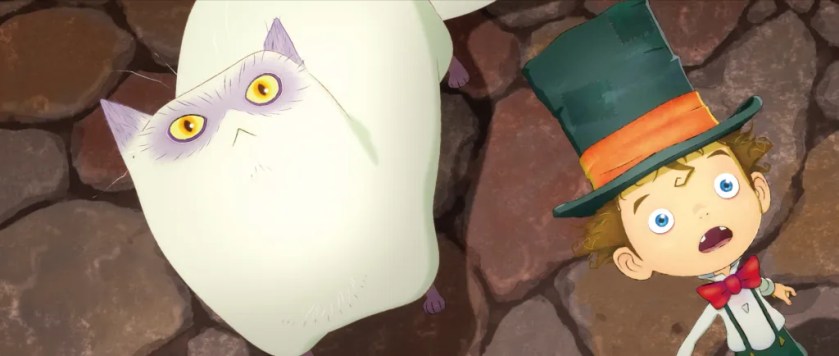
Director Yûsuke Hirota’s animated “Chimney Town: Frozen in Time:” is a visually stunning and emotionally rich family adventure that uses fantasy to explore some very real feelings about grief, memory, and learning how to move forward after loss.
The story follows young Lubicchi (voice of Yuzuna Nagase), who is devastated after losing his best friend, Poupelle (voice of Masataka Kubota). His sorrow leads him into a mysterious realm that governs time itself, a place where broken clocks are discarded and a lone tower stands with its clock permanently frozen at 11:59. In order to find his way home, Lubicchi must restart the clock and rediscover something he has lost along the way: the courage to believe.
It’s hard not to be immediately entranced by the film’s gorgeous animation. Blending expressive 3DCG character models with lush backgrounds, the movie creates a world that feels like a living storybook. The environments are packed with detail that give the film a whimsical quality that recalls the magical atmosphere of Studio Ghibli.
Even when the story becomes dense, the visuals remain consistently captivating. While this particular style of animation admittedly isn’t my personal favorite, I still found plenty to admire. I never completely lost myself in the world the way some viewers likely will, but I was consistently invested in the story and the emotional themes at its center.
The film is also elevated by its beautiful original score (by composer Harumi Fuuki), which adds tremendous emotional weight to every scene. The music perfectly complements the story’s sense of wonder and melancholy, helping audiences connect with Lubicchi’s journey through a world that is both enchanting and deeply sad.
This is a film about what it means to be frozen by grief. The image of a clock permanently stuck at 11:59 becomes a powerful metaphor for people who cling to the past because moving forward feels impossible. Through Lubicchi’s journey, the film explores the universal experience of loss and the difficult realization that healing often requires letting go.
The screenplay weaves surprisingly mature philosophical ideas into its fantastical narrative. It examines love, memory, faith, and legacy, asking how the people we lose continue to shape our lives long after they’re gone. Rather than suggesting we forget those we’ve loved, the film argues that their stories, lessons, and love live on through the people left behind. It’s a message that resonates equally with children and adults, and its quite beautiful.
Unfortunately, the film occasionally tries to do too much. Several storylines compete for attention, and the narrative can feel overloaded as new characters and ideas are introduced. A tighter edit and a sharper focus on Lubicchi’s central journey would have strengthened the film overall.
Despite that, “Chimney Town: Frozen in Time” remains a beautifully rendered and emotionally resonant film. It’s a fantastical adventure filled with imagination and whimsy, but beneath the magic lies a thoughtful meditation on grief, healing, and the importance of embracing new beginnings.
By: Louisa Moore

