
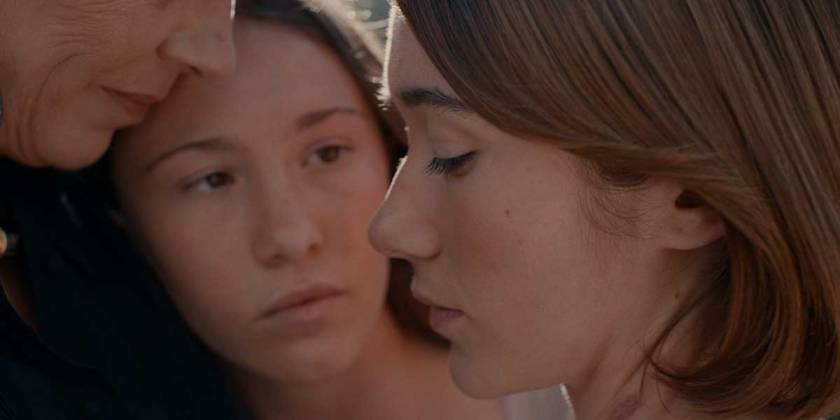
“Forastera” is a beautifully delicate film about grief, identity, and the strange emotional ways we carry the people we lose. Set against the dreamy backdrop of Mallorca, the movie begins like a carefree summer postcard, complete with turquoise Mediterranean water, lazy afternoons, teenage flirtations, and endless sunlight. It then becomes something much deeper and more haunting.
Teenage sisters Cata (Zoe Stein) and Eva (Martina Garcia) are spending the summer with their grandparents Catalina (Marta Angelat) and Tomeu (Lluís Homar) when tragedy suddenly disrupts their idyllic vacation. After Catalina unexpectedly dies, the film follows Cata as she begins coping with the loss in increasingly unsettling ways. She slips into her grandmother’s vintage dresses, adopts her mannerisms, and slowly starts filling the emotional role Catalina once held within the family.
The story remains nuanced and emotionally truthful rather than overly symbolic or melodramatic, which fits quite well with the directorial style of Lucía Aleñar Iglesias. Her filmmaking is subtle, patient, and remarkably confident for a feature debut. Rather than relying on big emotional confrontations, the film focuses on small gestures, quiet silences, and carefully observed family dynamics. Every detail inside the grandparents’ textured home feels meaningful, and the atmosphere gradually becomes more emotionally charged as Cata’s identity begins to blur with her grandmother’s memory.
The writing is especially strong, and it’s refreshing because Iglesias completely trusts her audience. The film understands that grief is often strange, confusing, and deeply tied to memory and routine. Cata isn’t simply mourning her grandmother, but she’s unconsciously using Catalina’s presence to shape her own developing sense of self. That idea is explored with a sensitivity that never feels forced. The film blends a coming-of-age drama with touches of magical realism, making it both grounded and dreamlike at the same time.
Quietly haunting, beautifully written, and filled with atmosphere, “Forastera” excels at being emotionally honest. It captures grief not as one dramatic event, but as a slow, disorienting process that reshapes the emotional balance of an entire family.
By: Louisa Moore

