
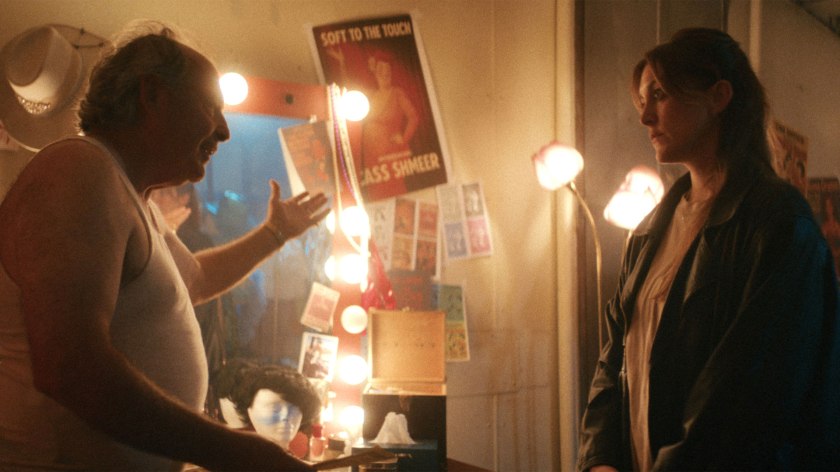
Director Jay Silverman’s “Yale” is a heartfelt, messy, and occasionally frustrating family drama that leans hard into emotional storytelling, sometimes to its benefit, and sometimes to its detriment.
The film follows Mac Mitchell (Caitlin McGee), a woman whose life has been shaped by abandonment, addiction, and repeated run-ins with the law. When her 12 year old son Ryan urgently needs a kidney transplant, she’s forced into the most painful kind of reckoning: reconnecting with the father who left her when she was nine. Yale Parker (Kevin Dunn) reappears after thirty years with a revelation that immediately complicates everything. He secretly has eight other families, and one of them may hold the key to saving Ryan’s life.
What starts as a desperate search becomes a road trip story about fractured identity, buried truth, and the strange ways families are connected. As Mac and Yale travel together to track down her half-siblings, the film shifts from confrontation to something more complicated and surprisingly tender. Their relationship doesn’t magically heal, but it does evolve in ways that feel earned, especially as both characters are forced to confront the long term consequences of abandonment and addiction.
The real heart of the story is its look at how trauma repeats itself across generations. Mac’s unresolved pain from childhood feeds directly into her struggles as an adult and her strained relationship with her own son. The film does a solid job showing how these cycles form, not in abstract terms, but in everyday behavior, resentment, and self-destruction. It’s also at its strongest when it focuses on Mac’s raw and unbearable desperation as a mother willing to do anything to save her child.
The performances are strong, and the cast leans into the material with sincerity. Even when the script gets a little (okay, a lot) heavy-handed, the actors keep it watchable. There’s a real effort here to portray flawed, deeply human people rather than clean or easily redeemable characters, and that goes a long way in making the family dynamics feel believable.
The film definitely overreaches at times. It’s too long, and you can feel it stretching itself to cover emotional aspects of the story that don’t always need as much emphasis as they get. Some moments veer into forced sentimentality, and a couple of the big twists land quite awkwardly.
Despite its unevenness, the film works more often than it doesn’t. It’s well made, emotionally sincere, and anchored by a compelling central premise that keeps things moving even through its weaker stretches. And while it occasionally uses melodrama as a crutch, it also carries a clear message about accountability, healing, and the importance of organ donation that feels genuinely meaningful rather than tacked on.
“Yale” is a flawed but engaging family road drama that may not always get the tone right, but tells its story with sincerity and heart.
By: Louisa Moore


I had the opportunity to watch YALE last week at DANCES WITH FILMS. I see hundreds of movies a year, and this was one of the best indie films I’ve seen in quite a while. Reminded me of LITTLE MISS SUNSHINE and NOBODY’S FOOL. Your review is emotionless, almost as if it was written by a robot. Not one word about it being a true story, and not one word about the use of comedy (albeit some bad comedy) in very serious scenes. Did it make you think about the relationship with your father? Did you laugh? Did you cry? This review is like reading a medical file.
LikeLike
Thank you for taking the time to share your thoughts on this one. I didn’t find any “Little Miss Sunshine” or “Nobody’s Fool” elements in this, but I am so glad it worked for you. This didn’t make me think about my relationship with my dad at all, but then again, he died when I was only 21 so I never really had the luck of developing a relationship with him as an adult. We all bring our own backgrounds into the films we watch and the reviews we write. I am very happy you loved this one so much. I thought it was good, but not great.
LikeLike