
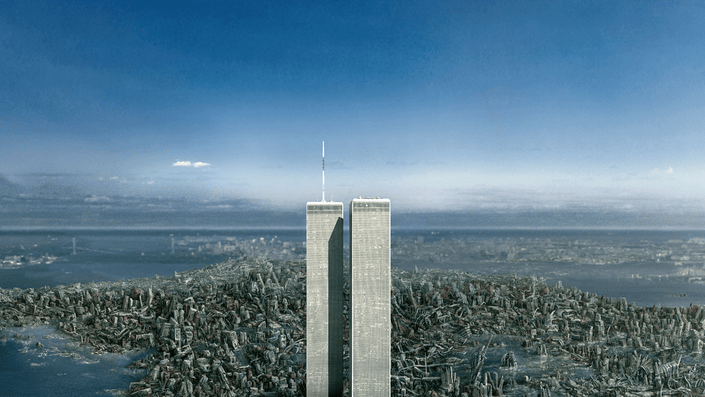
Director Sean Wilsey’s “IX XI” takes a different approach to telling the story of September 11. Instead of focusing on the politics, the attacks themselves, or the larger historical aftermath, the documentary stays close to the lives of twelve ordinary New Yorkers and the moments when their everyday routines collided with a world changing event.
That choice makes the film feel surprisingly intimate. These are not famous figures or people defined by acts of heroism. They are an actor, a cartoonist, a UPS employee, an immigrant, a professional skateboarder, and others from different corners of the city. Before 9/11, the Twin Towers were simply part of their landscape, a familiar presence in the background of daily life. The film does a good job showing how those buildings were not just symbols seen in photographs, but real landmarks woven into the identity and memories of the people who lived around them.
The most interesting thing about the film is how differently each person remembers the same day. Some recall specific details with incredible clarity, while others admit that time has changed the way they see the event. Wilsey understands that memory is messy and that trauma does not create one universal experience, but creates millions of individual ones. The film captures that complexity by allowing each person the space to tell their story in their own way.
Visually, the documentary takes a thoughtful and sometimes striking approach. Wilsey places his interview subjects in glassy pools, mirrored spaces, and reflective environments that echo the design of the World Trade Center and the 9/11 Memorial. Combined with archival footage and carefully chosen cinematic images, these choices give the film a feeling of memory itself (in fragments, reflections, and impressions rather than a straightforward historical timeline).
There are moments where the film struggles with its own structure, though. Some of the childhood stories and career backgrounds of the subjects go on longer than necessary, and parts of the documentary feel slowed down by details that do not always connect strongly to the central event. The pacing can certainly be described as uneven. There are also moments when some interviewees appear surprisingly casual as they talk about that day, smiling or laughing while discussing something deeply painful. It can initially feel uncomfortable, but grief does not always look the way we expect it to. People process trauma in different ways, and the film captures that unpredictability.
At its best, “IX XI” is less about September 11 as a historical event and more about how history settles into personal memory. It examines how a single moment can permanently reshape the way people understand a city, a place, and their own lives. It is a quiet, reflective documentary about memory, loss, and the strange ways ordinary people become connected by extraordinary events.
By: Louisa Moore

