
“The Brink of War” is a slow burn political drama built almost entirely on conversation, calculation, and the terrifying knowledge that the people in the room are negotiating with the fate of the world. For viewers who enjoy talky films about political gamesmanship, it has plenty to chew on.
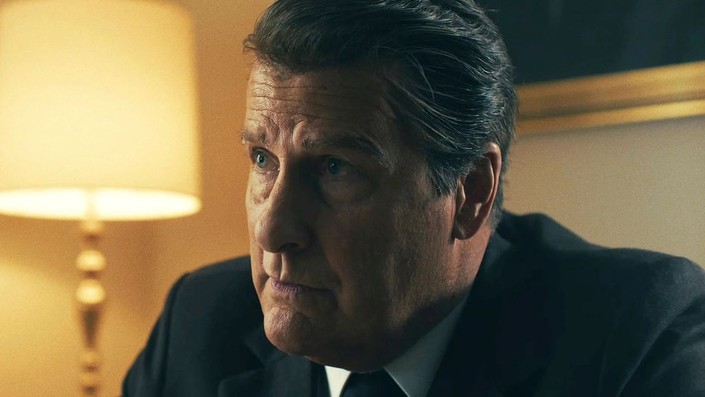
Michael Russell Gunn’s feature directorial debut dramatizes the 1986 Reykjavík Summit between President Ronald Reagan and Soviet leader Mikhail Gorbachev, drawing on declassified transcripts from their extraordinary 48-hour meeting. Jeff Daniels (who is horribly miscast here) plays Reagan and Jared Harris plays Gorbachev during a tense time where the two leaders arrive at Höfði House under enormous pressure from advisers, intelligence agencies, and their own governments. What follows is a political and psychological chess match, with every concession carrying potentially enormous consequences.
There’s something taxing about watching two men representing opposing political systems sit across from one another and engage in serious (and sometimes passive-aggressive) negotiations over nuclear disarmament. Gunn understands that the tension doesn’t require explosions or elaborate action sequences because the stakes are already terrifying enough. A badly chosen word, a moment of mistrust, or a refusal to compromise could have consequences for millions of people.
That makes the film surprisingly human as well as political. Reagan and Gorbachev aren’t presented simply as historical symbols of capitalism and communism, but as men trying to navigate an almost impossible situation while carrying the psychological burden of knowing what nuclear war would mean. I particularly liked the film’s depiction of a time when two leaders on opposite sides of an ideological divide could sit down and negotiate, seriously and respectfully, because they understood that finding common ground was more important than winning an argument. You know, the good old days.
Gunn also does a good job making the interiors of Höfði House feel claustrophobic rather than merely static. Shooting on location in Iceland (and reportedly using furniture from the actual summit) adds an impressive sense of authenticity. The naturalistic, 1980s media-style cinematography further reinforces the feeling that we’re watching history unfold rather than a glossy recreation of it.
There’s also a restrained religious thread, particularly in the contrast between Reagan’s Christian faith and the Soviet Union’s state atheism. Given the film’s association with Angel Studios, I was expecting the religious material to be more heavy-handed, but it generally remains part of the larger political and ideological conversation rather than taking over the movie.
The biggest problem is the casting, particularly with Daniels as Reagan. Daniels is a terrific actor, but his portrayal never fully captures Reagan’s distinctive voice, cadence, speech patterns or physical mannerisms. Because so much of the movie depends on these conversations, the disconnect becomes difficult to ignore. Instead of disappearing into the role, Daniels occasionally feels like an actor playing Reagan, which pulls you out of the drama.
The film’s deliberately restrained approach will also test some viewers’ patience. There are long stretches of people talking in rooms, and while the conversations are often compelling, the movie can sometimes feel more like a meticulously staged history lesson than a thriller. It’s stodgy in places, and the pacing occasionally works against the inherent drama of its subject.
The closer the negotiations get to the possibility of a historic nuclear agreement, the more chilling the movie becomes. Knowing that these events actually happened, and that the world really was this close to catastrophe, gives even the quietest exchanges an extraordinary sense of weight.
“The Brink of War” isn’t flashy, and it occasionally gets bogged down in its own seriousness. But as a tense, thoughtful portrait of diplomacy at its most consequential, it succeeds in making history feel immediate. Sometimes the most frightening battlefield is simply a room where everyone is trying very carefully to choose the next sentence.
By: Louisa Moore

