
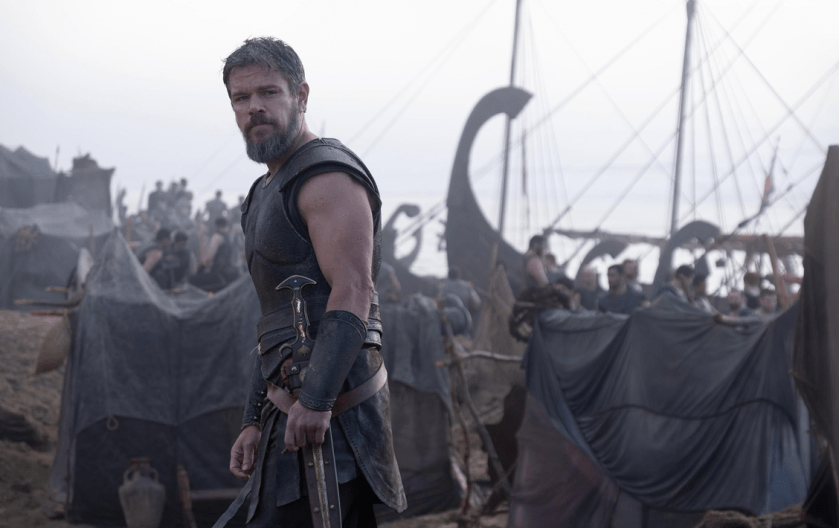
Before seeing director Christopher Nolan‘s highly anticipated version of “The Odyssey,” I figured I’d appreciate what it was trying to do more than actually love it. I couldn’t have been more wrong. Everything about it completely floored me, including how a movie on this epic scale could also feel so deeply personal.
It’s one of those rare films that left me with absolutely nothing to criticize.
Not one complaint.
Not one nitpick.
Just an incredible experience from beginning to end.
One of the most talented auteurs working in Hollywood today, Nolan has taken one of the greatest stories ever told and made it feel immediate, emotional, and thrilling all over again. This isn’t just a sword wielding and sandal wearing solider adventure packed with mythical creatures and giant set pieces. At its heart, it’s about a veteran trying to find his way back to the people he loves after years of unimaginable violence. Homecoming, loyalty, temptation, grief, identity, and the scars of war are all explored within the film’s carefully structured narrative without ever feeling heavy-handed.
Matt Damon gives one of the best performances of his career as Odysseus. His decade long journey isn’t driven by glory or conquest, but by the desperate hope of seeing his beloved and devoted wife Penelope (Anne Hathaway) and his son Telemachus (Tom Holland) again. Every monster, every obstacle, and every impossible decision feels like another reflection of the psychological burden he’s carrying. During his journey, Odysseus encounters plenty of menacing souls like the Cyclops (Bill Irwin), Circe (Samantha Morton), Calypso (Charlize Theron), and Sirens. They’re unforgettable characters on their own, but they also mirror the guilt, trauma, and loss that haunt him long after his brutal invasion of Troy.
What impressed me just as much was how Nolan structures the story. He moves between timelines and different perspectives with complete confidence, stacking exciting action sequences while keeping the emotional heart of the film from slipping away. Even across the film’s nearly three hour run time, I was completely locked in. Not once did I feel like the film was dragging.
Technically, this is Nolan’s biggest achievement, and I don’t think it’s particularly close. Ambitiously shot entirely on unwieldy IMAX 1570 (70mm) cameras, the movie is the first commercial narrative feature in cinema history to be filmed exclusively on IMAX’s highest resolution film format. The cinematography (from Director of Photography Hoyte van Hoytema) is otherworldly, and nearly every frame looks like it belongs in a museum. The practical effects give everything a tangible significance that’s becoming increasingly rare, creating that old fashioned sense of cinematic spectacle that makes you remember why seeing movies in a shared environment and on the biggest screen possible still matters.
The scale is breathtaking, but what amazed me most is how intimate it remains. For all its colossal battles, towering monsters, and sweeping landscapes, the film keeps returning to one simple question: what if the person who finally makes it home isn’t the same person who left? That powerful and meaningful idea runs through every scene, and Nolan deftly captures the ache of longing for home, the fear that war has changed you beyond recognition, the toll that leadership can take on a person, and the quiet hope that redemption is still possible.
Nolan also frames the story during the collapse of the Bronze Age, with a civilization slipping toward darkness after endless war. That backdrop gives the film an eerie relevance that becomes more than an ancient myth. It’s a reflection on humanity’s habit of repeating its own worst mistakes, and how violence leaves wounds that last long after the fighting ends. Why won’t we ever learn from history so we never repeat it?
For those seeking pure entertainment value, there is more than enough to satisfy. The action is thrilling, the story is engrossing, and there are even a few horror inspired sequences that ended up being some of the film’s most unforgettable moments. I know I sound overly enthusiastic, but I can’t praise this movie enough.
In short, everything works. The performances are outstanding (John Leguizamo as Eumaeus and Himesh Patel as Eurylochus are supporting standouts). The costumes feel authentic. Ludwig Göransson‘s score is phenomenal, swelling at exactly the right moments without overwhelming the emotion. The script is sharp, the dialogue is memorable and highly descriptive, and the storytelling is masterful. It’s technically precise but never cold, and intellectually rich without sacrificing excitement. You’ll gasp, cheer, and probably find yourself holding your breath more than once.
This is pure cinema. Rich, immersive, visually astonishing, emotionally devastating, and endlessly entertaining. An epic sweeping, stirring, existential adventure that somehow balances spectacle with genuine humanity. It’s a nonstop Hollywood epic in the best sense of the phrase, recalling the great classics while still feeling completely fresh.
For me, this is Christopher Nolan’s best film. Not just his most ambitious, but his most complete. It’s a monumental achievement that pushes large format filmmaking to another level while never losing sight of the people at the center of the story.
Cinema doesn’t get much better than this. “The Odyssey” is the most breathtaking epic I’ve ever experienced on the big screen, and a true masterpiece.
By: Louisa Moore


Godzilla Minus One still better
cope
LikeLike
Different movies, different goals. Godzilla Minus One has its strengths, but I don’t think enjoying The Odyssey requires anyone to cope. Would love to hear your thoughts on the film once you see it (I’m guessing you haven’t yet).
LikeLike
I’ll watch it tomorrow.
LikeLiked by 1 person
I don’t think you’ll be disappointed! Please let me know what you think, I can’t wait to see it again!
LikeLike