
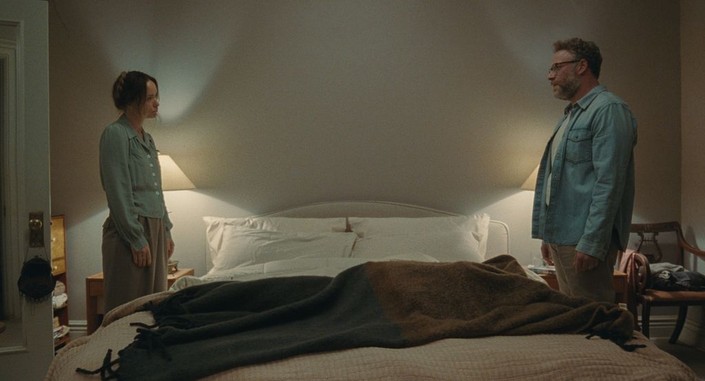
Some movies are designed to make you laugh. Others are designed to make you uncomfortable. Director Olivia Wilde’s “The Invite” manages to do both at the exact same time, and often within the same scene. It’s one of those films where you’ll catch yourself laughing at an awkward exchange before immediately cringing because it feels a little too real.
This intimate chamber dramedy revolves around Joe (Seth Rogen) and Angela (Wilde), a bickering couple whose marriage is quietly completely dying beneath the surface. When they invite their mysterious upstairs neighbors Piña (Penélope Cruz) and Hawk (Edward Norton) over for dinner, what begins as painfully polite small talk slowly transforms into an emotional minefield. Long-buried resentments, insecurities, unmet desires, and uncomfortable truths all come spilling out, and it’s a doozy.
The script, adapted from Cesc Gay’s acclaimed play by Rashida Jones and Will McCormack, is the film’s biggest winner. The dialogue is razor sharp and packed with witty observations and passive-aggressive barbs that feel painfully authentic. Conversations become performances, with everyone trying to project the image of the perfect relationship while quietly falling apart inside. The film understands that people in struggling marriages often spend more time talking at each other than actually communicating, and it mines that truth for both hilarious comedy and genuine heartbreak.
The cast couldn’t be better. Rogen brings exactly the sarcastic charm you’d expect, but he also finds surprising vulnerability as man who feels like a complete failure in life. Norton is the film’s secret weapon, delivering one hilarious scene after another with impeccable timing while constantly keeping you guessing about Hawk’s intentions. Cruz gives Piña an aloofness that’s wrapped in warmth and emotional intelligence that gradually shifts the entire evening, while Wilde makes the film’s most unlikeable character feel sympathetic.
With its verbiose nature, it would have been easy for the film to feel like a rigid stage play, and Wilde deserves enormous credit behind the camera. She turns a single apartment into a dynamic cinematic space, capturing the script’s shift in tone in a way that makes it all look so easy. Parts of the film belong in an outrageous, R-rated cringe comedy, but the story evolves into a deeper and very thoughtful examination of intimacy, trust, and what happens when two people begin growing in different directions.
The film asks whether a marriage can survive after the version of the relationship both people built together has effectively died. In a highly emotional scene, Piña suggests that Joe and Angela have only two choices: end their marriage completely or bury the unhealthy relationship they’ve been trapped in and build an entirely new one from scratch. It’s relationship advice 101 that’s rooted in therapy, but it hits especially hard here.
SPOILERS IN THE NEXT PARAGRAPH. Skip ahead if you have yet to see the film.
The final moments of the film are particularly beautiful. After a movie filled with weaponized dialogue and carefully crafted performances, Wilde strips almost all of the words away. Joe and Angela simply sit together in silence among the emotional wreckage of the evening. The ending refuses to offer easy answers. They may be separating, but a quiet moment shared over the piano hints they might also be choosing to rebuild something entirely different together. That ambiguity feels honest rather than frustrating.
Not everything works quite as well. Some of the dialogue occasionally feels a little too polished, as though the characters always have the perfect comeback ready. The score leans far too heavily on loud, intrusive string arrangements that works overtime to tell the audience how to feel instead of trusting the performances. Wilde also relies a bit too much on mirrors and reflective surfaces to symbolize Joe and Angela’s fractured marriage too, which becomes a highly distracting (and ultimately irritating) metaphor.
Still, those are relatively minor complaints in a film that’s so confidently written, directed, and performed. “The Invite” revitalizes the classic relationship drama by balancing uncomfortable comedy with genuine emotional insight. It’s funny, brutally honest, occasionally painful to watch, and deeply compassionate toward people trying to figure out whether love can survive after life changes them.
By: Louisa Moore

