
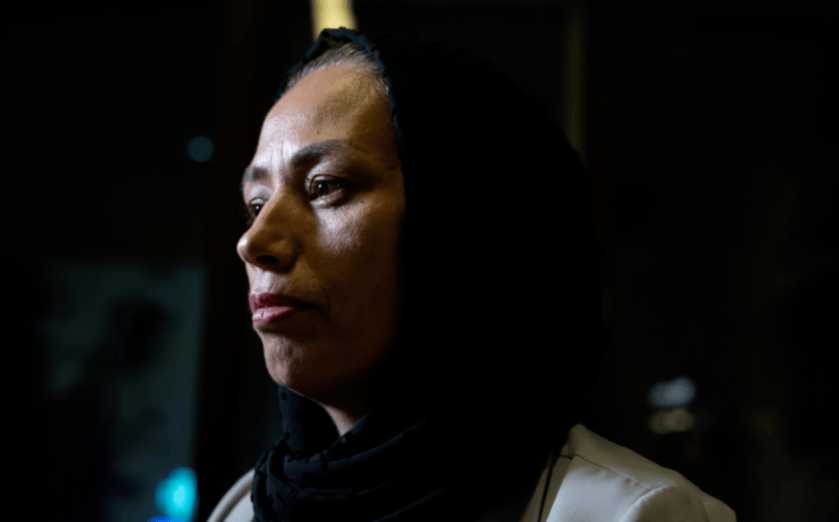
Tanaz Eshaghian and Farzad Jafari‘s documentary “An Eye for an Eye” wastes no time establishing the stakes, drawing viewers into a complicated and deeply personal story that continues to unfold with tension that grabs hold and never lets up. The film’s ability to balance the larger issues at play with the human experiences at its center keep it compelling from beginning to end.
Even though you know you’re watching real people instead of actors, the documentary plays with the tension of a great courtroom thriller. It’s an uneasy situation where every conversation matters and every negotiation could change someone’s fate. By the time the film ended, I realized I’d been holding my breath through much of it.
The film follows Tahereh, an Iranian woman sentenced to death after killing her abusive husband. What’s so devastating is that the story refuses to fit into neat categories. Tahereh openly (and quite casually) describes how she planned and carried out the killing, and there’s no attempt to soften those facts. At the same time, the film makes it impossible to ignore the years of abuse that pushed her to that point or the reality that she had repeatedly been denied a way out. It’s uncomfortable, morally complicated, and far more interesting because of it.
The documentary also raises unsettling questions about justice itself. Under Iran’s system of Qisas, human life becomes something that can be negotiated through diya, or blood money. The film exposes how this process places enormous moral pressure on families while also favoring those who have the financial resources to buy time and forgiveness. It’s a powerful reminder that poverty, domestic abuse, and the law can become dangerously intertwined.
What stayed with me most was Mohsen, Tahereh’s son. Watching him scramble to raise the blood money while negotiating with relatives who have the legal authority to decide whether his mother lives or dies is heartbreaking. He’s caught between loyalty, grief, responsibility, and desperation, and the documentary never treats him like a symbol, but a loving son trying to survive an impossible situation.
Eshaghian and Jafari deserve a tremendous amount of credit for the access they were able to get. The private negotiations, courtroom proceedings, and deeply personal family moments create the feeling that you’re witnessing events as they happen rather than watching a documentary assembled after the fact. Some of the arguments are so raw that they almost feel intrusive, yet that intimacy is exactly what gives the film its power.
The film refuses to turn anyone into a one-dimensional villain or hero. You understand the fury of the murdered man’s family, even when you disagree with their choices. You feel sympathy for Tahereh without forgetting that a man was killed. Most of all, you see how her children are forced to bear the emotional cost of a justice system that places the decision over life and death into the hands of grieving relatives.
The editing is exceptional as well. At just 84 minutes, the pacing is remarkably tight, building suspense with the precision of a psychological thriller. The countdown to Tahereh’s execution gives every scene genuine urgency, and the film uses that ticking clock to reveal the enormous psychological weight carried by everyone involved.
More than anything, “An Eye for an Eye” succeeds because it never feels like it’s telling you what to think. It presents an incredibly difficult story with honesty, compassion, and remarkable restraint, trusting viewers to wrestle with the contradictions on their own. It’s gripping, emotionally exhausting, and impossible to forget the people at the center of the story and the impossible choices they were forced to make.
By: Louisa Moore

