
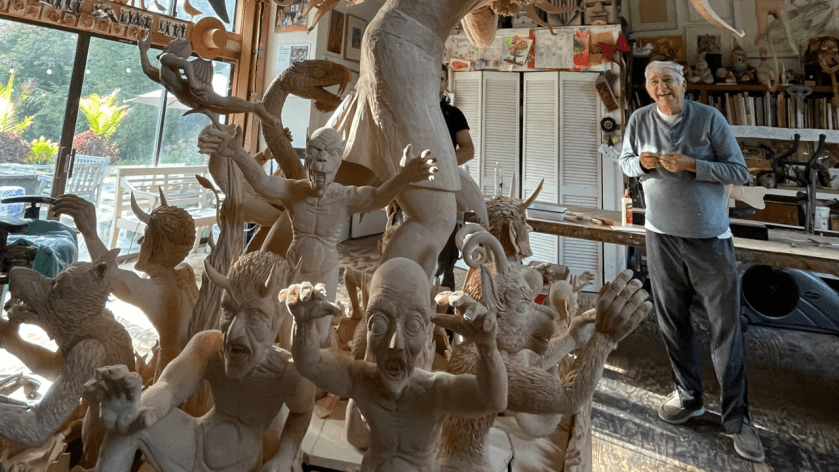
I went into director Cindy Meehl’s “Jimmy and the Demons” not knowing much about its subject, the artist James Grashow. But after watching this insightful documentary, I came out feeling like I’d spent a few years alongside him, hanging out in his studio and watching something deeply personal take shape in real time.
The film follows Jimmy as he takes on a massive and overwhelming project: carving “The Cathedral,” a detailed wooden sculpture packed with angels, demons, and big existential questions. Nearing 80, Jimmy casually calls this stage of life the “bottom of the ninth,” and you can feel that bittersweet ticking clock in everything he does. There’s urgency, but also a kind of stubborn joy to see that he’s slowing down. If anything, he’s pushing harder.
What I liked most about Meehl’s approach is how unpolished and honest her film feels, especially because she doesn’t try to glamorize the artistic process. You see the physical toll, the obsessive repetition, the moments where Jimmy isn’t sure what any of it means. And then, right in the middle of all that heaviness, he’ll crack a joke or shrug something off in a way that makes you laugh. That balance between humor and anxiety really carries the film, and it makes Jimmy a terrific subject.
Not only that, but he is incredibly easy to spend time with. Jimmy is thoughtful without being pretentious, and you get a real sense of how he sees the world. There are lengthy discussions about how cardboard can be just as meaningful as wood, why imperfection matters, and what inspires him to keep going. Watching him carve a series of wildly intricate demons while talking about love, mortality, and purpose also has a strange calming effect that is unexpected.
“Jimmy and the Demons” is a film about an artist, his art, and the extensive artistic process. As someone who admittedly gravitates towards documentaries about creatives, this is one of the more satisfying ones I’ve seen in a while. This is a story that’s as much about embracing the grind and the doubt as it is about inspiration, which makes the final piece feel earned in a way that’s hard to fake. Mostly, it’s just lovely to watch someone so fully committed to their craft, still curious, still wrestling with big questions, and still finding reasons to laugh while doing it.
By: Louisa Moore


Sounds good.
LikeLiked by 1 person