
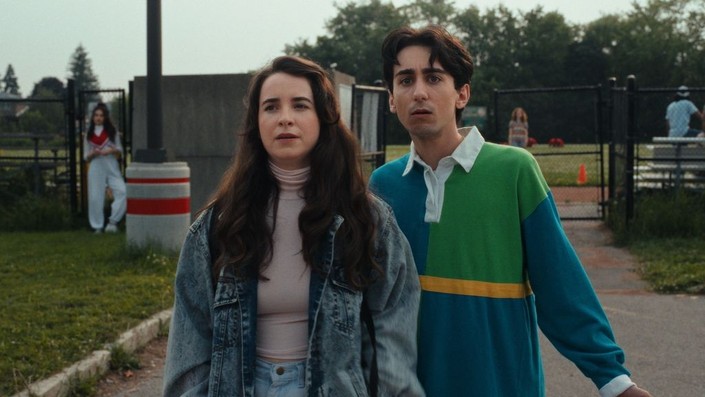
“All Is Fine in ’89” is like someone cracked open a late-night cable time capsule from the end of the 1980s and let it play out in real time. The film wears its influences proudly, paying obvious homage to the classic teen movies of the era, especially the work of John Hughes. But instead of just being a nostalgia trip, it tries to mix that familiar teen movie vibe with some darker themes and a historical moment that marked the end of an era.
The movie takes place on November 9, 1989, the night the fall of the Berlin Wall began. While the world is literally changing on the other side of the Atlantic, the students and teachers at Romano High are dealing with their own transitions during the last field party of the decade. For the seniors, it’s the final big blowout before graduation and the uncertain future that comes with adulthood. In a way, the movie is trying to mirror that shift with the bright, excess-filled Reagan-era 1980s fading into the unknown territory of the 1990s.
The story follows a handful of intersecting characters whose lives all collide at the party. There’s Mark (Adam Lupis), the classic nice guy “boy next door,” who’s mostly concerned with getting closer to his high school crush and finally taking their relationship to the next level. Unfortunately for him, his life is complicated by Cole (Tom Keat), the school bully and star jock who’s dealing with his own internal struggles, particularly a repressed sexuality in a time and environment that gives him few safe ways to express it.
Then there’s Linda (Dani Romero), who’s quietly carrying one of the heaviest storylines in the film. She’s secretly pregnant and stuck in an abusive home situation with nowhere to turn. The only adult she feels she can trust is Mrs. Applewood (Shelby Handley), the beloved teacher who acts like a surrogate mother to many of the students. Even she has complicated feelings of her own, including an uncomfortable crush on Dean (Dylan Hawco), the school’s effortlessly cool golden boy. Meanwhile, Mr. Parker (Damien Gulde), a lonely teacher who never quite fit in with anyone, sees the party as one last chance to feel included in something before life passes him by.
There are a lot of characters to keep up with, and all of these storylines weave together throughout the night. As the party unfolds, things get messy. Secrets come out, tensions explode, and several characters are forced to confront realities they’ve been trying to ignore. The film does a good job showing how the carefree image of teenage life can hide a lot of pain underneath the surface (talk about an ironic film title). On the outside, everyone is partying, flirting, and acting like everything’s great. Underneath, people are dealing with abuse, repression, bullying, and a deep fear about what comes next.
Writer and director Matthew Lupis nails the atmosphere of the late 80s The nostalgia factor is strong here, from the music and clothes to the overall vibe of the setting. It genuinely feels like the kind of movie that might have played on cable TV late at night during the time. There’s a grainy, slightly rough-around-the-edges quality to it that adds to the charm, making it feel like you’re watching something that got pulled straight from a VHS shelf.
At the same time, the film is surprisingly dark in places. While it starts off feeling like a classic teen party movie, it gradually moves into heavier territory as the characters’ struggles become clearer. Some of the themes, like domestic abuse, identity struggles, and the pressure of growing up, are handled with a lot more seriousness than you might expect from something that initially looks like a nostalgic throwback.
That said, the movie definitely leans into some very “of its time” elements too. There are a few sex scenes that feel a little unnecessary and mostly serve to reinforce the retro teen-movie vibe. It’s the kind of thing that makes the film feel even more like it stepped out of the late-’80s filmmaking playbook.
“All Is Fine in ’89” is an interesting mix of nostalgia and darker coming-of-age storytelling. Lupis clearly loves the classic teen films that inspired him, but also tries to dig a little deeper into the emotional realities behind that familiar high school movie formula. The result is a movie that feels both familiar and a little heavier than expected. If you’re someone who grew up on ’80s and ’90s teen movies, there’s a lot here that will feel recognizable, because growing up was never quite as simple as it looked.
By: Louisa Moore

