
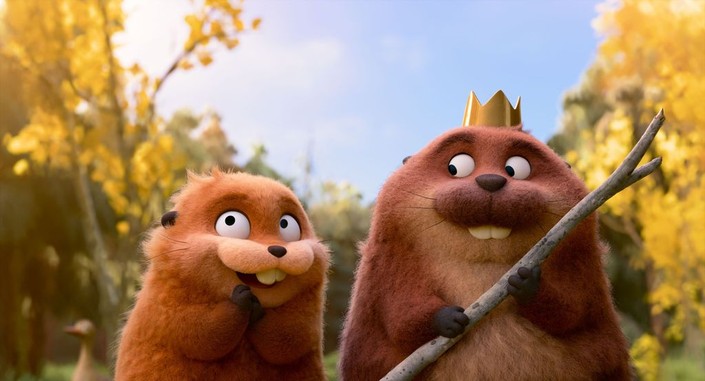
The Pixar animated adventure “Hoppers” is a delightful, heartfelt, and surprisingly thought-provoking film that manages to be funny, goofy, and moving all at once. The story follows the passionate and highly determined college student Mabel (voiced by Piper Curda), who discovers a secret experiment that allows her to transport her consciousness into the body of a robotic beaver. Her goal? To save a local glade that’s threatened by development and a noisy highway expansion. Along the way, she learns lessons about empathy, teamwork, and the importance of connecting with the natural world.
From the start, the film makes it clear that this isn’t just a cute story about animals, one about environmental stewardship, conservation, and the idea that every individual has the power to make a difference. It’s a movie with a clear and concise message that I hope won’t be lost on audiences.
One of the film’s strengths is how it balances whimsy and science fiction with meaningful themes. Consciousness-swapping into a robotic beaver is inherently fun and goofy, but it also allows the audience to explore the natural world from a completely new perspective. Mabel’s journey in the beaver body teaches her to see life from other points of view, to understand animals as part of an interconnected ecosystem, and to appreciate the consequences of human disruption on habitats. Beyond just environmental messages, the movie emphasizes that real change requires empathy and collaboration. Anger and frustration aren’t enough (no matter how justified); you also need to listen, compromise, and find common ground with your opponents.
Director and co-writer Daniel Chong, best known for the popular Cartoon Network series “We Bare Bears,” brings his signature tone and voice to the film. Fans of his previous work will recognize the balance of heart, comedy, and adventure, and it all pays off in a story that’s wildly original, heartfelt, and inspiring. His feature film is playful and weird, but it never loses its message about respecting animals, caring for the environment, and finding your own voice to make a difference.
Mabel is a fantastic protagonist. She’s brave, curious, and relentless in her pursuit of what’s right. She loves her grandmother and cherishes a special spot near her home where she feels closest to nature. Over the course of the story, Mabel learns that being impulsive and passionate is important, but so is accounting for other perspectives. She evolves from someone who steamrolls over obstacles to someone who inspires cooperation, proving that courage and integrity can move mountains. Her determination and heart make her a terrific role model, and the movie does a wonderful job of showing that caring about something bigger than yourself can be transformative.
The film’s supporting themes are equally strong. The story honors the laws of nature, showing predator and prey dynamics, the food chain, and the delicate balance of ecosystems without shying away from the dangers of the natural world. Teamwork, perseverance, courage, and trust are at the center of the narrative, too. Mabel and her friends learn that working together is the key to overcoming obstacles, repairing relationships, and making meaningful change. Connection, empathy, and action are intertwined.
Visually, the animation is irresistible, bringing the natural elements to life in ways that are rich, fun, and full of character. The animals are cute and expressive, the glade is lush and inviting, and the robot beaver design is clever and endearing. It’s the kind of world that makes you want to explore every corner, and the sci-fi concept of mind swapping adds a layer of imaginative fun that works well with the lighthearted humor.
“Hoppers” is basically everything you want from an animated adventure, serving up laughs, thrills, a little edge, and a big message about why caring about the world matters. And if you’ve ever wanted to talk to animals, this movie is basically a dream come true. Cute, clever, and heartfelt, it’s a film that’s fun for kids, meaningful for adults, and impossible not to love.
By: Louisa Moore
 Screen Zealots