
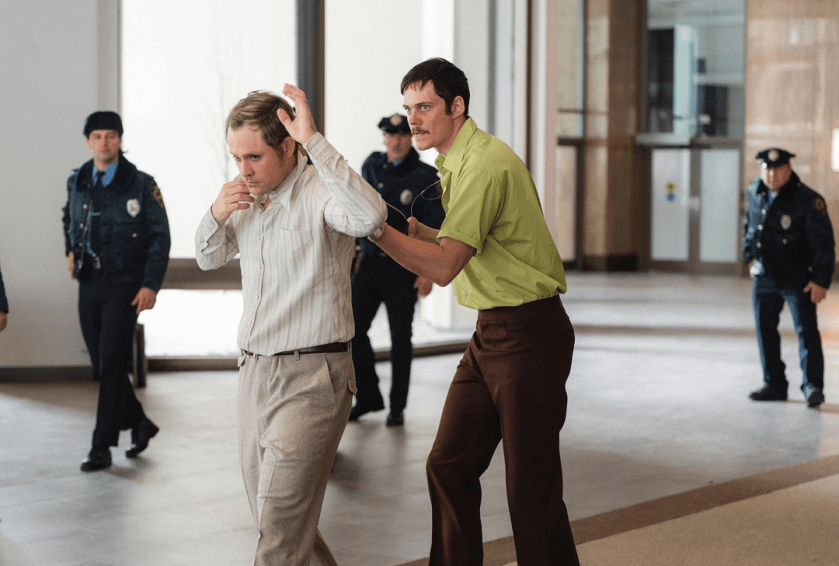
Director Gus Van Sant stays fully in his element with the true crime drama “Dead Man’s Wire,” capturing a 1970s authenticity so complete it feels like the film was literally unearthed from a time capsule. Every frame, from the lighting, the costumes, the cars, and the sets, oozes 1977, and the result is remarkably immersive. Van Sant nails the period’s look and vibe, creating a cinematic time machine that makes the film visually compelling even when the story itself meanders.
Based on the true events of February 8, 1977, the film tells the story of Tony Kiritsis (Bill Skarsgård), a man who took president of the Meridian Mortgage Company Richard Hall (Dacre Montgomery) hostage with a sawed-off shotgun wired to a potentially lethal “dead man’s wire.” The premise is tense and dramatic even if the story was fictional, but the fact that this is based on real life makes the stakes feel that much higher.
Despite a thrilling narrative, the storytelling is slow. This causes the film’s runtime sometimes feels longer than it should. The kidnapping itself is drawn out unnecessarily, and there isn’t much plot progression beyond the standoff. It’s fair to call the film’s pacing “sluggish,” but that slowness also allows Van Sant to explore mood, character, and the cultural texture of the era.
Skarsgård delivers a strong lead performance, though it veers into melodrama on occasion. Montgomery is terrific as a terrified banker who could be dead at any second with one wrong move. The supporting characters are memorable, too. Colman Domingo looks and fits his part as a local disc jockey drawn into the negotiations, Myha’la holds her own as a determined television reporter, and Al Pacino makes a memorable appearance in a minor role.
Beyond its Seventies authenticity, the film resonates with present day social and economic resentments. Tony’s desperation and anger at a system stacked against him (and causing him to lose his mortgage and forfeit his life’s dreams) echo the frustrations of the working and middle class, making the film oddly relevant despite its period setting. Van Sant taps into the allure of the outlaw folk hero with dark humor and sharp social commentary, exploring how ordinary people push back against the privileged elite and can sometimes win.
The darkness of this class resentment portrayed in the film makes “Dead Man’s Wire” intriguing and timely.
By: Louisa Moore

