

10. Are You There God? It’s Me, Margaret
“Are You There God? It’s Me, Margaret” is one of the first books I remember reading where I felt like the author really understood what it was like to be me. Judy Blume’s beloved book has been considered a rite of passage for many young girls, and the pressure of adapting the work for the screen had to be enormous for writer-director Kelly Fremon Craig. Thankfully, the film does the source material justice, creating a timeless coming-of-age story that brings the classic book to life.
Sixth grader Margaret (Abby Ryder Fortson) is 11 when she is unexpectedly uprooted from her life in New York City to the suburbs of New Jersey. Her mom Barbara (Rachel McAdams) and dad Herb (Benny Safdie) assure her that she will make new friends and get a fresh start at school. Margaret doesn’t want to move away from her loving grandma (Kathy Bates) either, who constantly reminds the family that she’s unhappy they’ve moved so far away. While her mom has difficulty adjusting to her new role as a homemaker, Margaret is quickly accepted by neighbor Nancy (Elle Graham) into her secret club for girls with fellow classmates Gretchen (Katherine Mallen Kupferer) and Janie (Amari Alexis Price). They meet after school to talk about the important things: boys, getting their periods, and their developing bodies.
The film stays mostly true to Blume’s original work, with a few potentially problematic things omitted and others added to build more drama. The novel heavily discusses religion, as Margaret’s mother was raised Christian and her father is Jewish, and the young girl struggles with finding a place where she belongs. Margaret prays to a god, but also asserts that she doesn’t believe in one. The film carries this theme well, and does not shy away from frank discussions about how religion divides people.
There are plenty of scenes about the ups and downs of puberty, one of the most confusing and taxing time in the life of an adolescent. The body shaming of classmate Laura (Isol Young) feels particularly relevant today, as does the instance when Margaret finally realizes that she’s become a bully herself and decides to change things.
Although I haven’t picked up the novel since I was 12 years old, certain scenes jolted the deepest recesses of my memory. Craig includes the most celebrated parts of Blume’s book, including Margaret’s major crush on neighborhood boy Moose (Aidan Wojtak-Hissong), bra shopping with mom, and perhaps the most famous of them all, “we must, we must, we must increase our bust!”
A minor criticism is that parts of the story feel rushed in favor of building a meatier history for the supporting characters. There’s a couple of new storylines that work well in the film, but sometimes it’s a tradeoff that feels unnecessary. In one of her smartest moves in dealing with the screen adaptation, Craig wisely keeps the story set in 1970, just like the original. It lends a heavy dose of nostalgia that takes you back to a time of innocence, an era without iPhones or the internet. I’m certain the film wouldn’t work as well if it took place in present day, and I’m so happy that the studio didn’t try to modernize the story. (Here’s hoping the timeless tale will still resonate with preteens today).
“Are You There God? It’s Me, Margaret” takes an enduring classic and turns it into a sweet, wholesome movie about growing up, the value of friendship, the support that comes from a loving family, and the very real struggle to find a sense of belonging in this world. It’s uplifting, perfectly cast, and accurately captures the most awkward time in a young girl’s life. In other words, it expresses the essence of Judy Blume’s most famous work.

9. Air
“Air” is a sports marketing drama that delivers satisfying entertainment with a feel-good, universal appeal. Never would I have guessed that a film about business deals and shoe marketing would be so engaging, but this true story about the game-changing partnership in 1984 between an NBA rookie named Michael Jordan and the athletic apparel company Nike is gratifying on all levels. You don’t have to be a basketball fan or even know anything about Jordan to enjoy this film. It’s a biopic all right – but of the men behind the Air Jordan sneaker line, not the superstar athlete.
Directed by Ben Affleck (who also co-stars), the film explores the history of how the legendary Air Jordan sneaker line was birthed into existence, telling the story of the high-stakes business gamble that had the potential to make or break Nike.
When scout and basketball division lead Sonny Vaccaro (Matt Damon) sets his sights on the talented UNC rookie (who has recently been drafted by the Chicago Bulls) to be the athlete that Nike needs to boost their shoe line, he is met with resistance from his team of reluctant colleagues. They’re skeptical at first, but eventually find Sonny’s passion to be contagious and hop on board.
Much of the narrative is focused on the behind-the-scenes company men, discussions about money, and valid concerns about taking a huge risk on Sonny’s gut feeling that this kid has the potential to become an international sports superstar. There’s a lot shown about the creativity process, brainstorming sessions, and outside-the-box marketing that helped Nike sell their shoes to an up-and-coming NBA player. Although it may sound like it, this isn’t a dry business story, but an enjoyable film filled with casual charm.
Affleck includes a who’s who of Nike in the 80s, from Peter Moore (Matthew Maher), Nike’s Creative Director and the man who designed the Air Jordan sneaker (and also had the brilliant idea to put Jordan’s silhouette on the product line), Howard White (Chris Tucker), who influenced the basketball player to sign with the company, Marketing Director Rob Strasser (Jason Bateman), and Nike co-founder Phil Knight (Affleck), who credits the Air Jordan as the product that saved his company.
A secondary plot line involves Sonny’s efforts to convince Jordan’s bulldog agent David Falk (Chris Messina) and family, in particular his smart and savvy mother Deloris (Viola Davis), to sign with Nike over the more popular competing brands Converse and Adidas. Discussions between Sonny and Deloris deliver the film’s most powerful scenes, especially when you see a tenacious mother who knows her son’s worth and has no problem holding her own in a room full of corporate suits. It’s unusual to find a film that keeps the audience invested in the story from both sides, and I found myself hoping for Sonny to land a great contract but also for Deloris to get the best deal possible for her son and family.
To reveal more about the story would constitute major spoilers, especially if you are unfamiliar with the history of the shoe, but Affleck’s storytelling is so engaging that it will keep you emotionally invested even if you know the eventual outcome.
As a director, Affleck has an enviable, natural flair for telling true stories. His casual style and instincts are on full display here. The film is an example of one of those instances that are few and far between, where the subject matter is the perfect match for the director. This is a story that obviously is close to Affleck’s heart, and it’s reflected throughout the film.
“Air” is a well-made movie about the American Dream from two different sides of the equation. There aren’t many missteps here, and everything from the direction, lively screenplay (written by Alex Convery), and warm performances all flow together in perfect harmony.

8. When Evil Lurks
Using the term “hard-hitting” to describe writer/director Demián Rugna‘s “When Evil Lurks” doesn’t even get close to characterizing what lies ahead for viewers of this savage, ruthless horror thriller. This tale of disturbing demonic possession is excessively cruel, unsettling, and brimming with blood and gore. In other words, it’s exactly the type of original film that horror fans crave.
In a remote village, brothers Pedro (Ezequiel Rodríguez) and Jimmy (Demián Salomón) discover a demon-infected man who has been left in a nearby farmhouse. With the evil presence affecting the local livestock, they attempt to recklessly remove him from their land. The brothers don’t follow the proper rules of exorcism, though, which aids the man in giving birth to what could be evil itself. A possession epidemic is triggered, infecting many in the community. Trying desperately to avoid anyone who is exposed, their only hope rests on the shoulders of a “cleaner” who claims to be able to stop the deadly plague.
From its opening scene, this supernatural shocker grabs you and pulls you in. Rugna has a crackerjack eye for building tension, and he goes the “show don’t tell” route in the majority of his movie. There’s no clear explanation or complicated narrative set up of what’s going on, especially early in the story, forcing viewers to just go with the known truth that possessions exist in this world. Accepting this as fact helps build on the curiosity and engagement with the phenomenon, the story, and the characters.
This is not your standard possession and exorcism movie, however. Rugna’s twist on the formula is bold and thoughtful, mainly because the church isn’t presented as a solution. There are no priests called in to offer assistance. There’s no holy water nor Bible verses read. There’s no amount of religion or prayer that is going to save these people, which gives the story a welcome, fresh perspective.
The film features absolutely terrifying, startling, and graphic imagery that will haunt you forever. There’s no holding back as Rugna goes full throttle and pushes the limits to the extreme. It’s relentless and harsh, with some of the most disturbing scenes featuring violence involving animals and children (sometimes both). This is a film where horrible things happen. Horrible. This is not a horror movie for the faint of heart or those with weak stomachs.
The tension is heightened not with cheap jump scares, but with truly terrifying story elements. This isn’t a film that relies on the easy scare, but one that is legitimately disturbing. “When Evil Lurks” is a breath of fresh air in the demonic possession horror subgenre.

7. Gran Turismo
Fans of movies about the little guy who comes out on top will want to pop the champagne for director Neill Blomkamp‘s “Gran Turismo” and its perfectly formulated underdog narrative. While it’s based on a true story about car racing and video games, no knowledge of either is necessary to enjoy Blomkamp’s crowd-pleasing, feel-good film that will appeal to just about everyone on planet Earth.
This biographical sports drama tells the fact-based story of Jann Mardenborough (Archie Madekwe), a teenager who turned his love of the Sony PlayStation racing simulator game Gran Turismo into an actual career as a race car driver. Jann’s gaming skills led him to be selected in an exclusive Nissan competition that selected the best “drivers” to get a shot at training to become a real-life professional racer at their exclusive GT Academy.
The film plays fast and loose with the facts of Mardenborough’s life, and it’s better not to spoil any of them by reading his biography beforehand. (Even if you check out his story afterward, be warned that you’re going to be disappointed). Does perfect accuracy really matter, though? By rewriting and a bit of history, the screenplay paints a touching portrait not only of the drive, determination, and conviction of one young man who was told he’d likely amount to nothing, but also into the exhilarating world of racing.
One of the movie’s strengths is its swift pacing, as Blomkamp manages to fit volumes of story into a short amount of time. What’s even better is that Mardenborough is a likeable kid who is made into a character that is effortless to root for, from the start of his journey at home to his success as a race car driver. He’s a terrific role model who is respectful, hard working, and passionate (but watch out for kids getting their own big ideas that they can turn a love of video games into a profitable career).
There’s a nice balance of drama and action, too. The portrayal of Jann’s relationships with his own former soccer star father Steve (Djimon Hounsou) and father figure / racing mentor Jack Salter (David Harbour) are genuinely touching to the point that you may wonder why someone is cutting onions nearby. The well-executed racing scenes are exciting, and there are plenty of crashes and near-misses that give the film bursts of action at near-perfect intervals. Every element of the movie seems like it was meticulously planned to offer maximum appeal, and it’s one of those rare projects that succeeds on every level.
There is likely going to be much criticism and pushback on the overt commercialism presented in the film, but that’s the world of racing for you. There are major corporate sponsors everywhere in the sport, from the exterior of the team cars to the uniforms of the drivers, and those logos are certainly in your face here. It’s realistic, but also packed with countless brand names. (One of the main characters, Danny Moore (Orlando Bloom), is a marketing executive at Nissan, and he never misses a chance to talk about how great his cars are). What’s amazing is that this is the only nitpicking I can find with this film.
“Gran Turismo” is an all-around terrific sports biopic with an emotional richness that goes full throttle. It’s inspirational, sentimental (but never corny), and sincere, proving that dreams really do come true.
6. Mission: Impossible – Dead Reckoning
The Tom Cruise “Mission Impossible” franchise is one of reliable quality and equally dependable “forgettable-ness.” I’ve seen every film, yet my memory is fuzzy when I try to recall what happened in any of them. And while it’s almost a given that “Mission: Impossible – Dead Reckoning Part One” will somehow sadly meet a similar fate, it’s still one of the best of the bunch. Not one thing disappointed me about this seventh installment in the series, an exciting and entertaining ride that gets almost everything right. This is an absolutely terrific action movie that overdelivers, and I loved every minute of it.
World class field agent Ethan Hunt (Tom Cruise) works as a field agent for an elite, top-secret branch of the CIA called the IMF (Impossible Mission Force). His team, including associates Luther (Ving Rhames), Benji (Simon Pegg), and Ilsa (Rebecca Ferguson) have become close friends, and they’re a well-oiled machine when working together. They regroup to embark on a dangerous mission to track down a new weapon that threatens all of humanity. The entire world is at stake, and Ethan must find a device before it falls into the wrong hands while dealing with some dark skeletons of his own past.
In order to get the most enjoyment out of the film, it’s best not to read too much about the plot. What works so well about the story is that it has a modern angle, and the motivations of the villains are extremely strong. The stakes are high and there’s a very real danger, which adds to the overall excitement. As one character puts it, they’re fighting “an enemy that’s everywhere and nowhere.” It’s smart, sophisticated, and polished in a way that tends to evade your typical summer blockbuster.
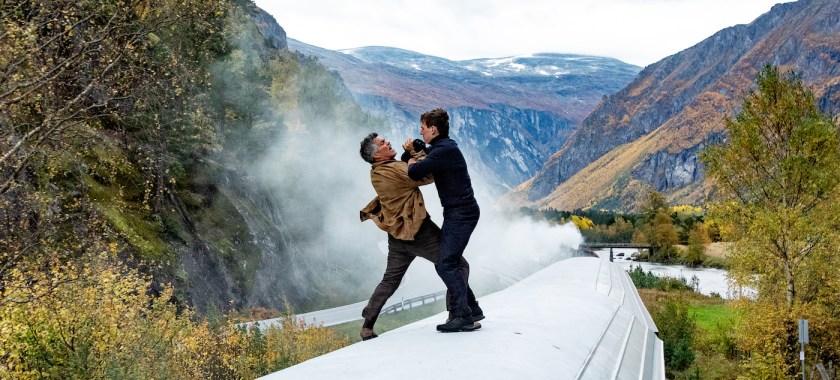
There are a few high tech, double cross, master of disguise elements, but they aren’t used as a distracting gimmick (as they sometimes have been in previous MI films). The high-concept action scenes are energetic and absolutely thrilling, making for some very clever and inventive spectacles. From a dramatic footrace through the canals of Venice to motorcycle jumps in the Austrian Alps to an epic car chase through the streets of Rome, there’s never a dull moment. There’s an inspired, extended sequence on a runaway train that will go down in history as one of the most creative and fun action scenes of the year, if not ever.
There are plenty of strong female characters in the story, including the new addition of Grace (Hayley Atwell), a crackerjack larcenist, and Paris (Pom Klementieff), a fierce bodyguard who gives off strong Harley Quinn vibes. This movie, simply put, is packed with badass women. Seeing the gang reunited is always fun, and Pegg and Rhames have created characters that feel like old friends. There’s excellent work from the supporting cast too (Vanessa Kirby, Esai Morales, and Shea Whigham). Cruise is starting to show his age, but he’s still one of Hollywood’s greatest working superstars. His performance is reliable, charismatic, and believable, which is exactly what it needs to be.
It’s clear that this is a movie that’s older and wiser and in turn, it’s made with more mature audiences in mind. Nothing is dumbed down, the emotional meter runs high, and the level of style and poise is unexpected and welcome (and to be commended). This is a classic espionage thriller that achieves a balance between artistry and pleasure, which is no easy feat.
“Mission: Impossible – Dead Reckoning” is the first part of a two part saga, but the finale isn’t so open-ended that it leads to frustration. Instead, it’s more of an excitement-based cliffhanger that’ll leave you salivating for the second half. This is a movie that could stand alone, but I’m awfully glad it doesn’t.
5. The Killer
Celebrated director David Fincher has a distinctive style, and it’s one that’s well-known and beloved by many cinephiles. There’s a passion that comes through in his latest project “The Killer,” a story adapted from the French graphic novel series by Alexis “Matz” Nolent. The film has an atmospheric tone that’s moody and brooding, but the darkly comedic moments paired with an acerbic cynicism combine for a wildly entertaining (and very smart) film. It’s like “Fight Club” and “The Girl With the Dragon Tattoo” came together to create the most Fincher-y movie ever. This film is a mood, and that mood screams David Fincher.
When a professional hitman (Michael Fassbender) botches an important, high profile job in Paris, he risks public exposure and must quickly get himself to a safe house in the Dominican Republic. When he arrives, he finds his lady friend has been nearly beaten to death by unknown assailants. Fueled by anger and a thirst for vengeance, the killer goes on a violent revenge bender to hunt those responsible for the attack.
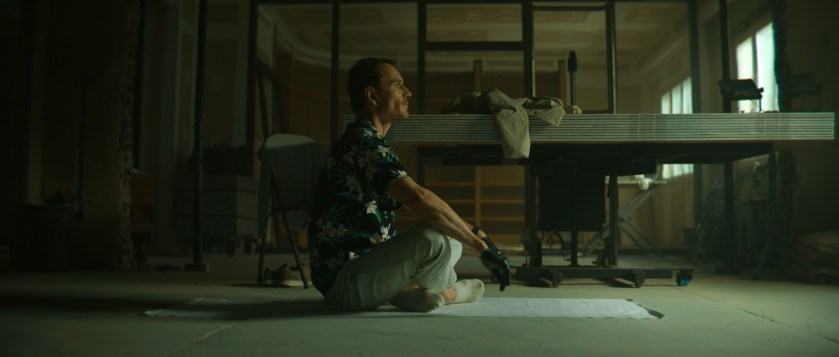
Fassbender has finally found a role that’s tailor-made to suit him, playing to every strength he has. Dare I say he is flawless here as a detail-oriented professional killer who has a penchant for noshing on protein and firing up a playlist featuring songs by the Smiths to get him in the zone. His character never reveals his name, making him an anonymous ghost in the crowd. He lives a life of routine with a job that just so happens to involve a sniper rifle. With a mantra of “anticipate, don’t improvise” and a proclivity to meticulously calculate every last detail, he’s a man who obsesses over it all. In a way, Fincher’s style mirrors his lead character, as he’s well known as being notoriously controlled and detailed.
Choosing to let the killer narrate his own story is a gutsy move, but Andrew Kevin Walker‘s writing is one of the strongest elements of the film. His prose is worldly, smart, and sophisticated (it’s one of my favorite scripts of the year). Fincher wisely lets Walker’s words do much of the heavy lifting.
The director’s visual style is in top form here too, including a thrilling fight to the death that feels disturbingly authentic and his signature precise stylistic choices like desaturated colors, a monochromatic palate, and shot blocking and composition that makes it clear you’re watching a Fincher project.
Fincher once again surrounds himself with the best talent, including an accomplished cast (featuring Tilda Swinton, Kerry O’Malley, and Charles Parnell) as well as reuniting with his “Se7en” screenwriter Walker and choosing to work once again with Trent Reznor and Atticus Ross (in their fifth collaboration with the director) to create a disconcerting, methodical score.
Stylish and visually striking, everything comes together to make “The Killer” a solid success of a film.

4. Spider-Man: Across the Spider-Verse
I don’t have that much to say about “Spider-Man: Across the Spider-Verse”, the sequel to the equally terrific 2018 Oscar winning film “Spider-Man: Into the Spider-Verse,” except that it’s easily one of the best films of the year. It’s the type of achievement in animation that’s not only artistically skilled but also wildly entertaining. This is one of the most perfect pieces of animated cinema in years and even better, it’s aimed squarely at more sophisticated audiences of older kids, teens, and adults.
Miles Morales (voice of Shameik Moore) is back for part two, and he’s happily fulfilling his duties as Brooklyn’s friendly neighborhood superhero. Miles finds himself joining forces with Gwen Stacy (voice of Hailee Steinfeld) and a new team of elite Spider heroes (featuring the voices of Jake Johnson, Karan Soni, Issa Rae, and others) from across the multiverse as they work together to fight off a powerful villain.
The plot is complex, but the story is terrific. The parallel universes at play don’t feel like a gimmick, and there are real stakes for every character. There are strong messages about teamwork, friendship, power, and responsibility, and it’s nice to see more female representation in a film that prides itself on diversity and inclusion. The story is a little slow at the start, but things pick up ones Miles enters the picture. His relationship with Gwen is developed extensively here, and they’re a great onscreen duo.
The film is computer-animated, and the visuals are nothing short of masterful. The animation is vibrant, skillfully executed, and absolutely stunning. This is the type of visual art that leaves your eyes begging for more. From the attention to detail to the choice of hues, there isn’t one misstep to be found.
The story, however, has a few stumbles, and most of that stems from the overly long run time (2 hours, 20 minutes), the too-insider Easter egg references for diehard comic fans, and the irritating cliffhanger ending that is so obnoxious that it almost ruins everything that came before. Thank goodness the rest of the movie is so much fun.
“Spider-Man: Across the Spider-Verse” is the type of film that proves animation isn’t just for kids, and it’s certainly not a throwaway medium that deserves to be dismissed. It’s an action-packed, visually dazzling, frentic, and outrageously fun piece of cinema. Go see it.

3. Poor Things
Greek “Weird Wave” director Yorgos Lanthimos has a reputation for his vigorous attraction to stories that embrace the most taboo elements of society, and “Poor Things” is one of the best in his unabashedly weird, dystopian filmography. In his latest, the director has created a feminist Frankenstein film that’s smart, witty, and packed with an awkward charm that delivers a strong pro-woman message with a deliciously off-kilter streak.
Unorthodox scientist Dr. Godwin Baker (Willem Dafoe) is in awe of his latest creation Bella (Emma Stone, in a gutsy, physical, and demanding role), a young woman who has been reanimated in his laboratory. She has the mind of a child, but is maturing rapidly. As her new brain develops, it becomes clear that Bella is far more than just another experiment. Eager to learn more about the world, Bella runs off with the debauched lawyer Duncan Wedderburn (Mark Ruffalo) for a whirlwind adventure across the globe. This leads to a series of eye-opening experiences that truly turn Bella into her own woman.
It’s a great idea for a story, especially as Frankenstein’s monster is reimagined as a sexually-charged being. The film is graphic, explicit, and not for the faint of heart. Bella’s frank and unfiltered comments are often as hysterical as they are based in truth, and the character’s unique perspective lends an eye-opening view of the world. Free from shame, it’s refreshing to see a young woman set off with a wealth of curiosity and compassion in her quest for exploration, especially when her mission is equality and liberation. It’s not that Bella is free from the misogynistic gender constructs of the world, she is just blissfully unaware.
There is a lot to unpack here, including rousing themes of feminism, sexual freedom, and admiration from the worldliness one can only gain from personal experience. As Bella evolves, she goes from a tantrum-throwing toddler to a young and uninhibited woman who gives into her most basic, primal desires with glee and a wild abandon. She learns right from wrong when it comes to things like the proper use of violence, the concept of consent, and how to behave like a lady in public. It’s quite funny, but also sincere as she grows as a person. Bella becomes a woman with agency who has total and complete control over her own decisions and body. In the process, she also develops empathy and learns about kindness and true intimacy.
“Poor Things” is a creative fantasy that’s flush with timely themes and plenty of material that is certain to spark controversy and intellectual discussion. It’s inventive and eccentric and one of the most notable films of the year.

2. Anatomy of a Fall
There is a sophisticated complexity to co-writer and director Justine Triet‘s “Anatomy of a Fall” that makes it one of the more challenging and ambitious films of the year. This is a highly suspenseful murder mystery that isn’t about unraveling the secret of who did it, how, or why, but about the complicated and continuously shifting perceptions the audience has of the accused. It’s a smart, taut drama about family and relationships, with Triet and co-writer Arthur Harari offering up a keen character study in their incredibly nuanced, detailed screenplay.
Sandra (Sandra Hüller) is a successful German novelist who lives in the French Alps with her less-successful writer husband Samuel (Samuel Theis) and their visually impaired son, Daniel (Milo Machado Graner). She is accused of murdering her husband after Samuel’s body is found outside in the snow, underneath an open third story window. There are no witnesses, as Daniel was out walking the family dog at the time of his father’s death. The police question whether Samuel was murdered or committed suicide but with a need to find someone to blame, Sandra becomes the main suspect. This leads to an investigation not only into the circumstances surrounding the man’s death, but into the deepest corners of the couple’s rocky relationship.
The film has elements of both true crime and courtroom dramas, as there is an investigation into the suspicious, deadly fall as everyone attempts to piece together an accident, a suicide, or a possible crime. When very little concrete evidence is found, members of the legal system begin to examine Samuel and Sandra’s marriage instead. This leads to an invasive public dissection of the couple’s tumultuous relationship, exposing a past history that’s highly emotional for this troubled family.
Smart and riveting, the script creates an ambiguity around the deceased and the accused. It becomes clear that facts don’t matter as much as how people see you and prefer their own version of the truth. Perceptions, distortions, and speculation are all weapons wielded towards Sandra in court as she faces a legal system that creates motives that may or may not have been there. Lawyers, jurors, and even the judge create their own fiction when it comes to Sandra’s guilt or innocence. With a lack of absolute proof, evidence is taken out of context. All of this fosters a great deal of doubt, leaving viewers to scrutinize every detail, every gesture, every memory.
There is a feminist spin to the story that acknowledges the sexist notions present in society, and the courtroom is a misogynistic place where everything that gives Sandra power is turned against her (her education, her career, her lack of natural maternal instincts, her sexuality). It feels like everyone wants her to be guilty, so they are throwing everything at the wall to see if anything will stick. It’s upsetting to watch, and is highly emotionally effective.
While this is a film that focuses on language and nuanced storytelling, Triet masterfully creates an overwhelming feeling of anxiety that reaches almost unbearable levels. The story takes place in just two confined locations: the family’s isolated mountain chalet and a hostile courtroom. Hüller and Graner give outstanding performances that are flush with a disquieting ambiguity that continuously sow the seeds of doubt. The aggressive (and almost combative) use of music amps up the tension even further.
This isn’t a typical whodunit true crime thriller, but a compelling story of a relationship sick with discontent and a fractured family. “Anatomy of a Fall” isn’t a film you simply watch, it’s one you experience.

1. The Holdovers
The moody, melancholy undercurrent that can sometimes permeate the holiday season is masterfully expressed in “The Holdovers,” a story that’s brimming with themes of loneliness, grief, and regret. Although this is a film that deals with the absence of family, director Alexander Payne and writer David Hemingson lend just enough wit and brevity to create a well-rounded coming-of-age story that’s not only heartwarming, but has the potential to become a Christmas classic for sophisticates with a sentimental streak. I loved everything about this film, and it’s one of the very best of the year.
Set in 1970, Paul Hunham (Paul Giamatti) is a curmudgeonly instructor at an elite New England boarding school. He’s not particularly well liked by his students nor his peers, and this year he’s being forced to remain on campus during Christmas break to babysit the “holdovers,” a handful of students who have nowhere else to go. After a few of the other students find alternate arrangements, Hunham is left with Angus (Dominic Sessa), the smartest guy at school as well as the troublemaker of the bunch.
When Hunham’s pompous arrogance collides with Angus’s belligerent attitude, the two spend their time antagonizing each other with great delight. Their war of words calms only when fellow holdover Mary (Da’Vine Joy Randolph), the school’s cafeteria cook and grieving mother of a teenage son recently killed in the Vietnam War, reminds them that all they have is each other this holiday season. Stranded together for two weeks, the trio bonds over a common sense of loss, isolation, and a nagging fear of being alone and unloved.
It’s a highly affecting story that’s elevated by the rich complexity of the characters and strong turns from the cast. Sessa is a newcomer who makes a name for himself here as a neglected teen, and Randolph will break your heart as a mother who masks her sadness by always carrying herself with grace behind a brave face. This is Giamatti’s stellar moment, though, as he gives the performance of his career as a lonely intellectual — a role that’s tailor-made to his strengths. The flawed protagonists are all sympathetic, everyone here is hurting, and although it sounds cliché, they find a pure sense of strength and companionship in each other.
Payne directs Hemingson’s script with a knowing tenderness that emanates a deep understanding of the material. There’s just the right balance of melancholy and humor, which makes the film feel painfully honest as well as sentimental and touching. It’s like a hug for those who really, really could use one.
The film looks and feels like a time capsule from the 70s, with nostalgic, grainy-textured cinematography and purposeful song choices for the soundtrack that work in tandem to set the tone. This is the kind of movie you’ll want to make an effort to see in an actual theater rather than streaming at home on the couch.
From the mutual respect between a teacher and his student to recognizing the possibilities that the future could hold, this film spoke to me on the deepest level. Bittersweet, hopeful, and poetic, there is just so much to love about “The Holdovers.”
___________________________________________________________________________
HONORABLE MENTIONS coming soon!
Among some of my favorites of the year, these films came close to cracking the top 10:
 Screen Zealots