
Based on author Andy Weir‘s bestselling science fiction thriller, co-directors Phil Lord and Christopher Miller‘s “Project Hail Mary” is the kind of big budget movie that feels refreshingly confident in its audience. It doesn’t sand down its science or seek to over explain every concept for mass appeal. Instead, it leans into problem solving, curiosity, and the joy of figuring things out. That alone makes it resonate with me, especially in an era where spectacle often trumps substance. This is a film that not only has a terrific story with mass appeal, but it’s also a quietly inspiring ode to scientific thinking.
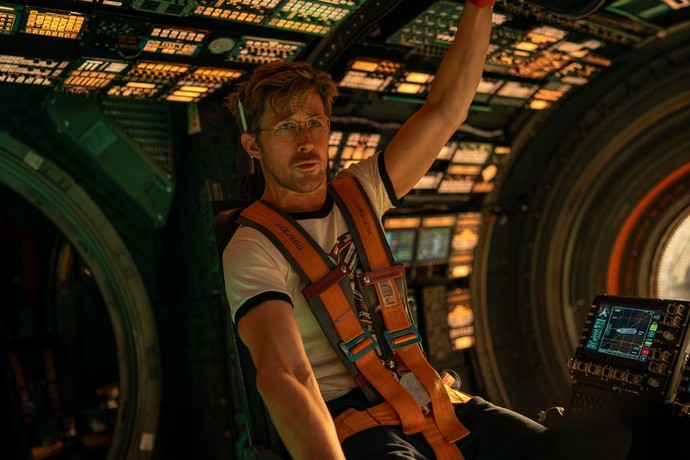
The story follows Ryland Grace (Ryan Gosling), a science teacher who wakes up on a spaceship with no recollection of how he got there. As fragments of his past gradually resurface, he realizes he’s on a critical mission to uncover the secret of a mysterious energy-consuming organism that is draining the sun’s energy. With time running out and the planet in danger of freezing to death from a dying sun, Grace must rely on his scientific expertise and quick thinking to save humanity, but an unexpected friendship means he won’t have to do it alone.
Yes, this is a story about aliens. About humanity. About teamwork. About solving the impossible. The narrative relies on logic, experimentation, and persistence. Science isn’t just window dressing here, but the language of the film. Watching problems get broken down, tested, and reworked becomes as compelling as any action sequence, and this blockbuster actually makes the scientific method feel heroic. What becomes the heart of the story is the sweet and charming friendship between Grace and Rocky (voice of James Ortiz), a pairing that illustrates how trust and a shared purpose can transcend even the most extreme barriers (like language, biology, and even entire solar systems). The film underscores themes of empathy and communication, which is a message the world certainly could use a lot more of in today’s current climate.
The screenplay (co-written by Weir and Drew Goddard) appropriately condenses some of the more complex aspects of the novel in an easier-to-digest visual storytelling format. The film still has a lot on its mind, especially as it explores sacrifice, celebrates curiosity as a driving force, frames teamwork as essential to survival, and reinforces the idea that courage often comes from having someone or something to be brave for. It’s earnest in a way that feels a bit old fashioned, but that sincerity works in its favor.
Although much of the story is based on real science, a healthy suspension of disbelief is absolutely required. There are some noticeable plot holes that require a bit of generosity from the audience, and the pacing is sometimes draggy as the timeline shifts between past and present. The film runs long, and at times it seems like entire sections of the story are missing (likely casualties of adapting a dense novel into a single film). You can feel the gaps, even if the overall journey remains engaging.
Still, those issues are easy to overlook because of how much the film gets right. It’s thoughtful, ambitious, and emotionally resonant, with a strong central performance from Gosling and a story that genuinely believes in the power of science and human (and non-human) connection. “Project Hail Mary” is the kind of smart, optimistic sci-fi that’s hard not to root for, and one that blends brains and hope in a way that’s irresistible. It’s the kind of story I wish we saw out of Hollywood more often.
By: Louisa Moore
 Screen Zealots