
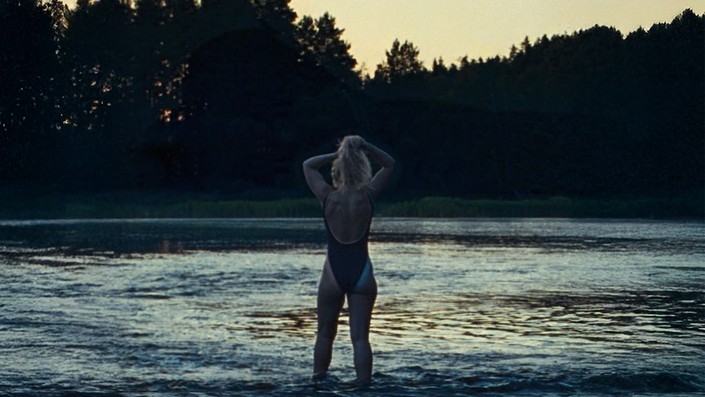
I really dug the fluidity of “The Chronology of Water,” the feature directorial debut from Kristen Stewart. This unsettling film navigates a woman’s emotional healing with a raw, sexually charged and wholly angry point of view.
Adapted from Lidia Yuknavitch’s beloved cult memoir, the film unfolds as an unflinching portrait of womanhood, survival, and self invention that’s told at the fragmented crossroads of memory and art. Stewart’s stylish storytelling gives the film a distinct and abrasive identity that fits the subject matter so well.
Imogen Poots stars as Lidia, a young woman raised in an abusive home who initially finds escape through competitive swimming in the Pacific Northwest of the 1980s. When her athletic aspirations collapse, the film follows her through love, addiction, sexual discovery, near-motherhood, and a lot of self-destruction, tracing how writing ultimately becomes an act of survival.
Water operates as the film’s central metaphor of freedom, memory, and pain, which weaves the story together as Stewart embraces a nonlinear structure. Trauma isn’t explained so much as experienced. Lidia’s childhood abuse, drug use, and self-harm surface abruptly, reinforcing the film’s unsettling (and unpredictable) atmosphere.
Stewart takes an experimental approach that lends a lot of directorial confidence to her first feature, but her too-artsy viewpoint may also prove to be an obstacle for mainstream audiences. The story also drifts through an overlong runtime that could desperately use some editing.
Still, the film’s commitment to embodying the female experience (particularly the reclamation of the body, desire, and meaning through pain) feels uncompromising and rare. An intentionally tough watch, “The Chronology of Water” is casually unafraid of mess, discomfort, or excess.
By: Louisa Moore
 Screen Zealots