
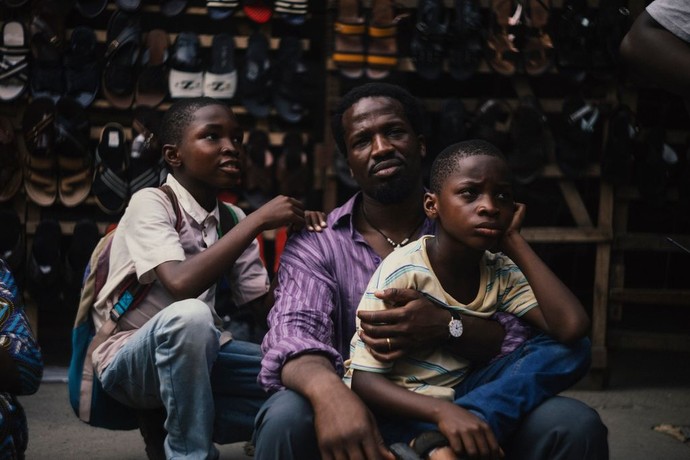
Director Akinola Davies’ incredibly personal debut feature “My Father’s Shadow” offers an intimate family portrait set against the political uncertainty of 1993 Lagos. Framed during a pivotal national election that signals a possible transition from military rule to democracy, the film follows young brothers Remi (Chibuike Marvellous Egbo) and Akin (Godwin Egbo) as they spend a single day accompanying their distant father Folarin (Sope Dirisu) into the city to collect his long-overdue salary.
Told largely through the boys’ perspective, the film captures their limited understanding of the adult world and the gradual realization of their father’s emotional and moral complexity. Lagos is rendered with striking sensory detail that’s so vibrant and chaotic, serving as both a physical landscape and an emotional mirror to the strained relationship at the film’s center. Davies resists overt exposition, instead allowing meaning to emerge through quiet observations and everyday interactions between father, sons, and the world.
Folarin is a character that’s written with as much honestly as complexity, embodying a man who is caring yet emotionally distant, burdened by responsibility and personal failure. This perceptive film offers a nuanced exploration of Black masculinity and presents fatherhood as a space of tenderness, absence, and unspoken longing rather than simple authority.
Davies uses a lyrical visual language to tell his story, balancing the personal with the political. Deeper meanings emerge from the small moments that unfold amid national unrest, some of which parallel the relationship of a father and his sons. “My Father’s Shadow” is a tumultuous story that manages to be intimate as well as expansive.
By: Louisa Moore
 Screen Zealots