
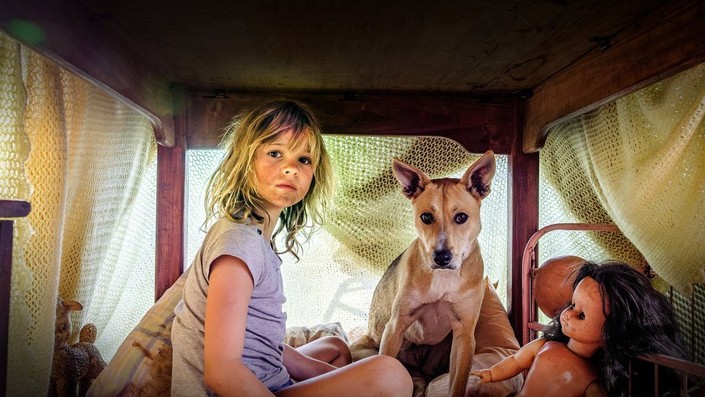
In her quietly searing adaptation of Alexandra Fuller’s memoir, actor-turned-director Embeth Davidtz delivers an intimate film version of “Don’t Let’s Go to the Dogs Tonight.” This complex and unsettling story explores the collapse of white colonial rule in Rhodesia through the eyes of eight-year-old Bobo (Lexi Venter) as the country edges toward its pivotal 1980 election and its rebirth as Zimbabwe.
Set during the final days of the Rhodesian Bush War, the film takes place on the Fuller family’s white-owned farm where daily existence oscillates between routine and terror. Bobo’s mother Nicola (Davidtz) is a woman so hardened by fear and grief that sleeps with a machine gun always within easy reach. At the ready to fend off snakes, “terrorists,” or anything else that threatens her fragile sense of control, Nicola teaches her daughter to see danger everywhere. She particularly afraid of Black Africans, which accurately reveals how prejudice is inherited as much as it is taught.
The film keeps the momentum going with a shifting perspective. Through Bobo’s eyes, the audience experiences moments of wonder and childish humor alongside sudden, brutal encounters with death. Bobo’s curiosity and resilience becomes the heart of the film, especially as the adult world around her collapses into alcoholism, paranoia, and even nihilism.
The story gives a sharper view of history through characters like Sarah (Zikhona Bali) and Jacob (Fumani N. Shilubana), Black workers on the Fuller farm who quietly endure the white family’s desperation while preparing for a future in which stolen land may finally be reclaimed. While the story is still told through the lens of a white settler child (and therefore limited by that perspective), the film is acutely aware of those limitations. The biases of the Fuller family are never accepted or condoned. Instead, they are exposed, examined, and allowed to rot onscreen.
The themes at play here are all quite serious, especially since the story grapples with racism, white privilege, mental illness, substance abuse, grief, and political violence. No one here is a clear hero or villain, just humans behaving as humans do. Despite the most heated of conflicts, people act out of fear, love, desperation, and deeply flawed belief systems shaped by their environment, even when they make bad decisions.
“Don’t Let’s Go to the Dogs” contains genuinely disturbing moments that often feel overwhelming, but it is precisely this refusal to soften its edges that makes it so compelling. Davidtz has crafted a work that is both personal and politically resonant, one that highlights the danger of inherited prejudice while honoring the resilience and curiosity of a child trying to make sense of a world built on contradictions.
By: Louisa Moore
 Screen Zealots