
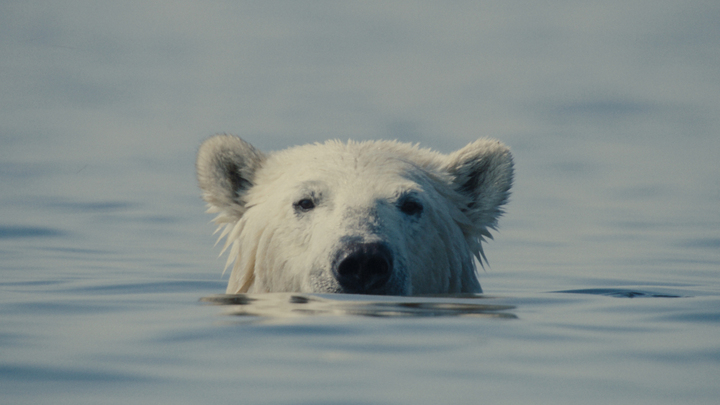
“Nuisance Bear” is an equally breathtaking and deeply affecting wildlife documentary that explores the complex world of polar bears navigating a human-dominated landscape. Filmmakers Gabriela Osio Vanden and Jack Weisman travel to Churchill, Manitoba, an area nicknamed the “Polar Bear Capital of the World,” to craft a portrait of coexistence that’s fraught with tension, beauty, and ethical ambiguity.
The film follows a single polar bear as it traverses a town crowded with tourists, wildlife officers, and management systems designed to contain it. Branded a nuisance for simply trying to survive, the bear’s journey becomes an intimate look at what it truly means to share the planet with these majestic creatures (and also how we are failing them). Guided by an Inuit narrator, the documentary gives Indigenous perspectives on the Arctic landscape and differing approaches to conservation.
This is a visually stunning documentary. The cinematography captures the harsh Arctic environment, the ferocious elegance of the polar bears, and their surprising cleverness as they slip past barriers, outwit traps, and navigate interference from mostly well-meaning humans. Watching the methods humans use to manage bears, from food traps to fireworks and helicopter chases, are jarring (and upsetting) when seen from the animal’s perspective.
Sedation and relocation, both popular ways to remove “problem” bears, reveal a truly sad truth: that survival in a human-altered world is filled with fear and confusion for these creatures. A particularly heartbreaking moment occurs when a bear wakes from sedation, dropped far from his home. He’s alone and his eyes seem filled with loss, uncertainty, and sadness. This scene alone absolutely destroyed me emotionally, underscoring the fact that humans are the ones encroaching on his home. We have to do, and be, better than this.
The documentary also branches out to take a look at the systems and economies that surround human and bear interactions, from tourism that borders on exploitation to management strategies that may do more harm than good. Vanden and Weisman draw a parallel between the experiences of the bears with those of the local Inuit communities who live alongside these animals without benefiting from the tourism economy. There are a lot of complex questions raised about ethics, equity, and stewardship, and the answers are far from easy.
Unfortunately, the documentary occasionally shies away from delivering a harder-hitting critique of the human behaviors driving these conflicts. The film presents evidence suggesting that polar bear populations may not be as endangered as often portrayed, which is a fact that challenges both conservation narratives and the economic interests that rely on them. This begs the consideration that maybe the best thing for native wildlife is to just leave them alone.
Gorgeous, powerful, and heartbreaking, “Nuisance Bear” is an elegant and thought-provoking meditation on resilience, coexistence, and responsibility. It is a reminder that humans share this planet with magnificent creatures who deserve space, respect, and protection, not interference. Anyone who cares about wildlife, ethics, or the natural world should see this documentary.
By: Louisa Moore
 Screen Zealots