
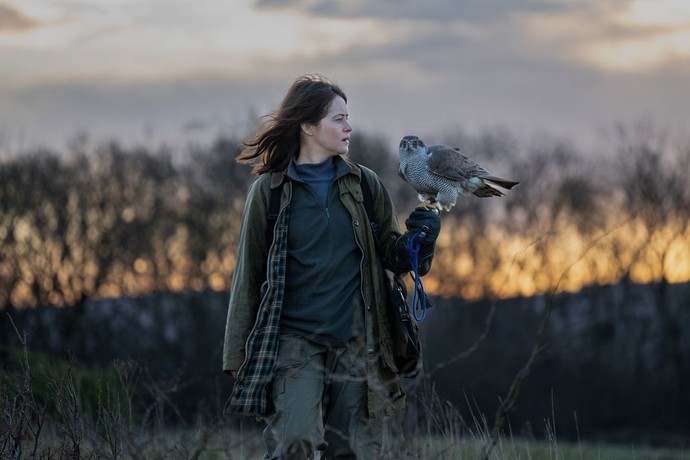
In an adaptation of Helen Macdonald’s memoir, “H Is for Hawk” is an intimate, quietly reflective story that leans heavily into mood and metaphor as it explores grief, memory, and the uneasy comfort of the natural world.
The film tells the story of Helen (Claire Foy) and her retreat into the ancient and demanding practice of falconry after the sudden death of her father (Brendan Gleeson). What unfolds is a beautiful, meditative process that’s shaped by loss, discipline, and the slow and painful work of emotional survival.
Foy delivers a restrained performance that suits the material well. Helen is emotionally withdrawn and living in fragments of memory (like the beloved birding trips shared with her father) while pouring all of her focus into training Mabel, a wild and fiercely unyielding goshawk. The act of taming the bird becomes a mirror for Helen’s internal state, as she is also raw and resistant to easy comfort. The film thoughtfully draws on the history and lore of falconry, reinforcing the idea that grief is both deeply personal and historically shared.
The film’s themes hit all the familiar notes of loss, the healing power of nature, and the way wildness can reflect human pain. The symbolism is clear and overly tidy, and while the emotional arc is sincere, it doesn’t always feel especially original. The idea of healing through communion with nature has been well-trodden territory, and the film doesn’t radically reframe that concept, even as it presents it with care and sensitivity.
Where the film finds its strength is in its emotional honesty. As Helen teaches Mabel to hunt and eventually fly free, she’s forced to confront how thoroughly she’s neglected her own life and emotions. What begins as an act of endurance slowly transforms into something gentler and more hopeful. It’s a recognition that healing (like falconry) requires patience, humility, and acceptance.
“H Is for Hawk” may lean too heavily into the familiar, but it’s a thoughtful, quietly profound meditation on grief and the fragile process of learning how to live again.
By: Louisa Moore
 Screen Zealots