
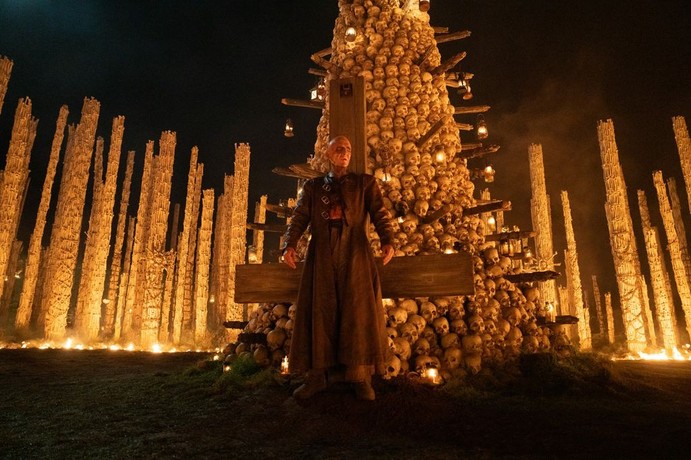
I’m so excited about the new life being breathed into the zombie franchise with “28 Years Later: The Bone Temple,” a strange and brutal entry into the “28 Days” canon. The film works better as a piece of standalone dystopian horror than as a meaningful continuation of the franchise, and it feels unnecessary to the larger mythology. Maybe that’s because it is barely a zombie movie in the traditional sense, using the infected more as background noise while focusing on a harsher truth: that the real monsters in a post-apocalyptic world are actually the human survivors.
In what has already become an iconic character in modern cinema, Dr. Kelson (Ralph Fiennes) is at the center of the story here. The narrative follows Spike (Alfie Williams) as he finds himself trapped in a violent faith-based cult led by Jimmy (Jack O’Connell). They’re part of a roving gang that thrives on violence and bloodshed, and it seems the boy has little room for escape.
The film leans hard into philosophical territory, contrasting spirituality and scientific reasoning while exploring themes of fascism, survival, and the erosion of identity. A cult-like society becomes the lens through which power, ideology, science, faith, and cruelty are examined, making it clear this isn’t a dumbed-down sequel, but a refreshingly intellectual, ideas-forward film draped in horror aesthetics.
Of course, horror fans won’t object to the relentlessly graphic imagery. The violence is extreme and often disturbing, with heads and spines ripped from bodies and skulls cracked open. Human brains are eaten, people are tortured, skinned, burned alive, and impaled, with blood spurting in excess. The brutality and gore is not subtle and it won’t be for everyone, but it does serve the film’s bleak worldview.
By shifting the focus from family to the nature of evil itself, the film feels very different from the previous installment. It questions what it means to remain human in a world stripped of morality, which sometimes includes finding compassion in unexpected places (like the doctor’s bond with an infected) while depicting survivors as increasingly inhuman. In this story, the infected are no longer the sole threat, but the cruelty, ideology, and desperation of those left behind prove far more terrifying.
Messy, punishing, and provocative, “28 Years Later: The Bone Temple” is extremely unsettling. This is intellectual horror functioning at its highest level.
By: Louisa Moore
 Screen Zealots