
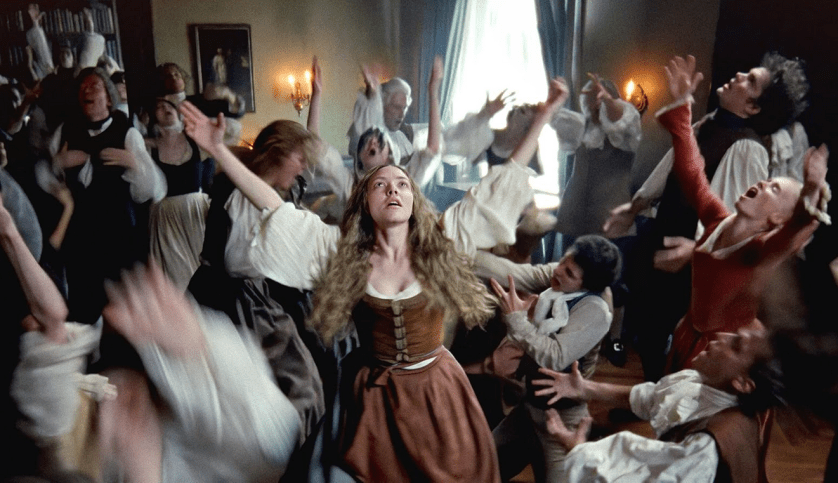
“The Testament of Ann Lee” is an experimental period piece that on paper shouldn’t work at all, and yet somehow it becomes utterly electrifying. This audacious, dark, and deeply compelling historical feminist fable is staged with a boldness that lends an exciting and somewhat reckless energy to a tale that could have been dull and dry. Director Mona Fastvold approaches the story of the founder of the Shaker movement not with conventional historical drama, but with the full vocabulary of musical theater. There’s repetitive sing-song chanting, ritualistic choreography, and performance art style sequences of movement and dance. It sounds bizarre, but Fastvold takes her creative vision to the next level.
Fastvold’s retelling of Lee’s (Amanda Seyfried) history is speculative but also grounded in truth. The film explores Lee’s relationships with her husband Abraham (Christopher Abbott) and her devoted brother (Lewis Pullman) while situating her spiritual movement within larger questions of legacy, gender, and the cost of belief. The worship ceremonies are depicted with frenzied energy (and become even more lively when backed by Daniel Blumberg’s original score), functioning as a communal expression of longing and release that becomes a sort of substitute for the sexuality the sect renounced.
In what has become one of my favorite lead performances of the year, Seyfried’s intense and mesmerizing turn as Lee is unforgettable. Seyfried gives Lee a core of ferocity and fragility, tracing her transformation from a gifted and devout child to a woman marked by profound trauma. As a woman who experienced unimaginable tragedy (Lee lost all of her children in infancy), Lee was shaped into a radical visionary advocating for equality, pacifism, and a Utopian society. Seyfried captures the contradictions of a mystic, religious leader, grieving mother, and a woman forging an entirely new way of being in the world. It’s a demanding, complex role and she carries it with ease and grace.
The film’s hybrid form is well-suited to the material. The Shakers worshipped through trembling, singing, and exuberant physical devotion, and Fastvold turns those practices into fully realized musical numbers with interpretive dance rituals and religious chants transformed into song. What might have come off as pretentious instead feels feverish, immersive, and unexpectedly riveting. The result is unlike anything else, especially as Fastvold sets the scene with stark interiors and dreamlike landscapes. This is a historical portrait delivered through spectacle, spiritual reverie, and experimental theater.
In its harsh depiction of grief, faith, and the struggle to imagine a better world, “The Testament of Ann Lee” is definitely a dark film. This daring reimagining of a woman who helped shape American religious identity is told through a style that seems wildly inappropriate until you realize just how well it works. Admirable in its audacity, unforgettable in its execution, and a triumph of vision over expectation, this film is unlike anything you have ever seen. Challenge yourself to watch this.
By: Louisa Moore
 Screen Zealots