
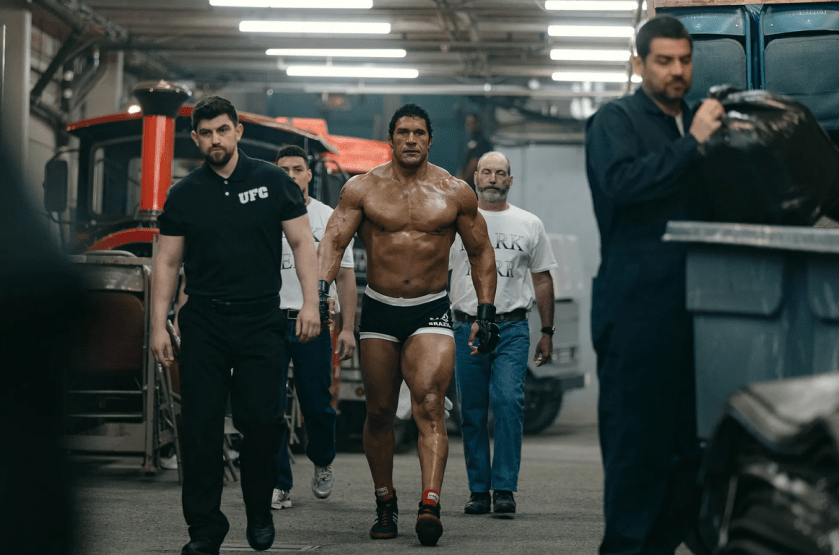
“The Smashing Machine” is an often punishing film experience, one that bears all the hallmarks of writer and director Benny Safdie’s unmistakable artistic approach. The restless handheld camerawork, heightened realism, and persistent undercurrent of anxiety are immediately recognizable, creating a sense of immersion that is technically impressive but deeply unenjoyable. While the film is undeniably a Safdie project through and through, that consistency in style does not necessarily make the film more accessible or engaging.
On paper, the story is compelling enough. Mark Kerr (Dwayne Johnson) was a pioneering figure in the formative years of mixed martial arts, a dominant physical presence whose success came at an immense personal cost. This biopic charts Kerr’s rise in the brutal, loosely regulated early days of the UFC and follows his gradual unraveling as the physical demands of the sport, constant travel, and reliance on painkillers begin to erode his body and emotional stability. His transformation from a reserved, gentle giant into a deeply troubled athlete struggling with addiction is rich material for a character-driven drama, and the film competently outlines this trajectory. As someone who isn’t a fan of MMA, however, I found watching this movie to be a total chore and a bore.
The performances are strong but not showy. Johnson is nearly unrecognizable beneath extensive prosthetic makeup, and he commits fully to portraying Kerr’s physicality and internal strain. Emily Blunt brings empathy to the role of Dawn Staples, Kerr’s devoted partner, but her performance is mostly lost in the supporting shuffle. The issue is not a lack of commitment from anyone in the cast, but the weight of the director’s stylistic choices that often bury the performances.
Safdie leans heavily into a quasi-documentary approach, blending staged scenes with appearances by real MMA figures and even Kerr himself. This strategy lends the film a sense of authenticity and historical immediacy, but it also results in a cold, unrelenting viewing experience. The fights, the travel, and the cycles of addiction are presented with such blunt persistence that they begin to feel more like an endurance test than a work of art that’s designed to draw the audience in. The realism is admirable, but it makes for a real mess of a movie.
Although “The Smashing Machine” deliberately avoids many of the familiar clichés of a conventional sports biopic, it sputters into a cold retelling that has almost zero narrative momentum. Safdie’s focus feels too narrow, and even he can’t sustain the exhausting rhythm of the narrative. This is a film that may resonate with viewers who are deeply invested in MMA history, but it’s not one that general audiences will likely enjoy for its storytelling.
By: Louisa Moore
 Screen Zealots