
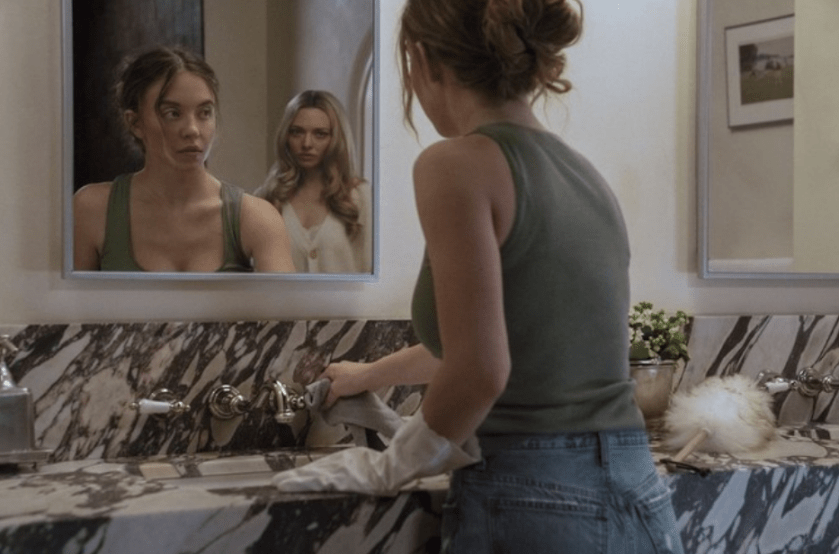
Director Paul Feig clearly wants his big screen version of Freida McFadden‘s bestselling novel “The Housemaid” to be a racy, subversive thriller about power, secrets, and women reclaiming control, but what he actually delivers is a trashy, shallow mess that mistakes shock value for substance. Framed as a sleek suburban nightmare, the film positions itself as prestige pulp. It has a facade of being dangerous, sexy, and socially aware, but collapses almost immediately under the weight of its own self-importance. Every moment screams with a longing to be provocative, yet nothing about it feels earned, daring, or even particularly entertaining.
The setup is familiar to the point of parody. Down-on-her-luck Millie (Sydney Sweeney) takes a live-in housekeeping job for Nina (Amanda Seyfried), an icy, brittle rich woman married to a controlling husband (Brandon Sklenar) in a picture-perfect mansion. From the moment Millie crosses the threshold, the movie telegraphs its intentions with all the subtlety of a foghorn. Secrets lurk behind closed doors. Power dynamics are skewed. Everyone is lying. And yes, the house itself is a metaphor (one so obvious it may as well turn to the camera and explain itself). You can feel the “big twist” coming from miles away and when it finally arrives, it’s not shocking or clever. This film is so aggressively stupid it becomes laughable.
What’s most frustrating is how smug the movie is about its own emptiness. Feig piles on voyeuristic scenes, ominous stares, and overwrought confrontations that mistake cruelty for depth. The film gestures toward themes of abuse, class resentment, and female solidarity, but it handles them with such clumsiness that they end up feeling exploitative rather than empowering. It feels like the film fetishizes (and even gets close to celebrating) acts of degradation rather than successfully using them to make a powerful statement.
The characters are barely fleshed out at all. Millie and Nina are written less as people and more as delivery systems for plot twists, with almost zero psychological complexity. When the women evolve into stronger, more defiant figures, it feels like nothing more than a box the screenplay has to check to justify its nastiness. The film wants credit for depicting women taking control but it can’t be bothered to give them believable inner lives. Empowerment here isn’t discovered, but is slapped on in the final act like a cheap label.
I think the story would have worked much better if Feig had picked a lane and stayed in it. Tonally, he can’t seem to decide whether he wants his film to be camp, satire, a psychological thriller, or straight melodrama, so it ends up being none of them. Scenes drag on endlessly, and attempts at light horror are undercut by laughable dialogue and ridiculous plotting. In other words, it’s a mess.
It’s a shame “The Housemaid” lacks the sharp satire, psychological bite, and suspense that Feig has been known to handle so well. Instead, the film is a sour and unpleasant experience that’s lazy, mean-spirited, and embarrassingly obvious. If you’re looking for a smart, tense thriller with something to say, this one isn’t it.
By: Louisa Moore
 Screen Zealots