
The lush, mournful, and beautifully crafted “Hamnet” takes a deeply personal approach to one of the most mythologized figures in Western literature. Instead of focusing on Shakespeare the legend, director Chloé Zhao turns her lens toward Shakespeare the husband, the father, and the grieving man whose art was shaped by unimaginable loss. Based on Maggie O’Farrell’s novel, the film imagines how the death of his young son Hamnet (Jacobi Jupe) may have quietly informed the creation of “Hamlet” not through direct biography, but through emotional truth.
From the start, Zhao creates a world that feels both intimate and slightly haunted. There’s a constant sense of foreboding baked into the romance between Will (Paul Mescal) and Agnes (Jessie Buckley), played with incredible depth by the two leads. Their early love is tender and almost magical, but you can feel the storm clouds gathering long before tragedy strikes. It’s crystal clear that this story is going to end in tragedy.
Buckley is unsurprisingly fantastic as Agnes, radiating a kind of earthy strength that keeps the film grounded. Despite her doing so much with the role, Buckley’s performance does go right up to the edge at times, with repetitive, intense, and overwhelming screaming and wailing. It works for the story, but it definitely provides a “your mileage may vary” element where some viewers may find it cathartic and others may find it a bit much. No matter on which side you land, Buckley undeniably captures the full weight of a mother’s grief in a way that feels both huge and painfully human.
Equally impressive, Mescal quietly matches her with a performance that’s less showy but just as affecting. His Shakespeare is not a towering genius but a man struggling to navigate guilt, sorrow, and the pressure of his own talent. Mescal brings an understated power to the role, letting you feel the emotional undercurrent rather than spelling it out. His chemistry with Buckley creates a lot of the film’s emotional force.
The story moves back and forth in time, shifting between the days surrounding Hamnet’s death and earlier moments of the family’s life. This structure keeps the tension simmering, even though we know where it’s all headed. Zhao’s direction leans into atmosphere with soft light, hushed tones, and a deep focus on the characters’ inner lives. It’s slow (very slow) at times, but intentionally so. She wants us to sit in the grief, the quiet moments, and the long silences that follow loss.
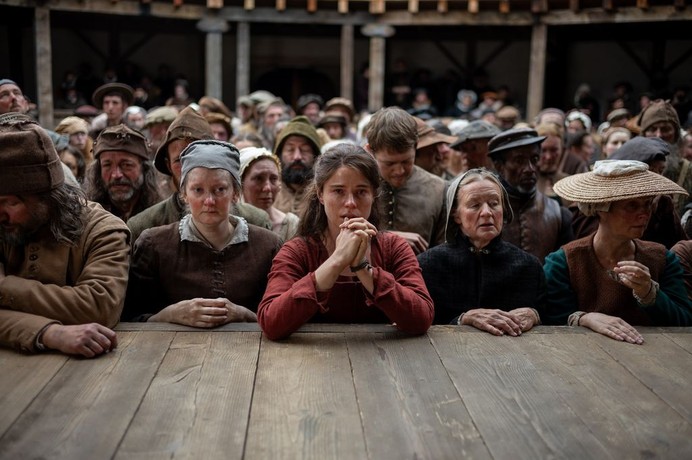
The final act is where the film may divide audiences. Zhao incorporates extended sequences that lean heavily into stage play aesthetics, and while they’re thematically meaningful (illustrating how grief becomes art, and how “Hamlet” might have been born from unspeakable pain), they undeniably drag down the pacing. The movie is already deliberate, and this stretch makes it feel even longer. Still, you can see why she does it: the staging creates a bridge between personal grief and theatrical expression, showing how Shakespeare might have tried to process and honor his son’s memory through performance.
The film explores love, motherhood, partnership, grief, the weight of artistic creation, and the ways people process trauma differently. It’s about connection, resilience, artistry, and the fragile bonds that carry families through their darkest moments. It is not just a film about death.
“Hamnet” may be a very sad film, but it is also a tender and deeply reflective one.
By: Louisa Moore
 Screen Zealots