
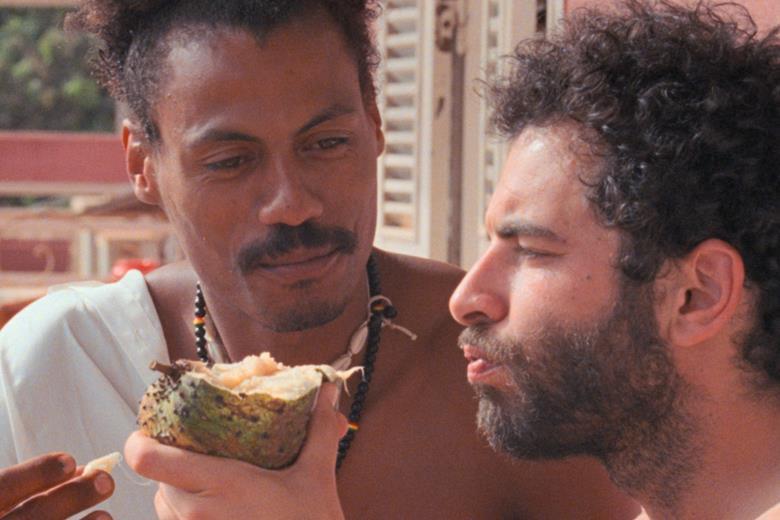
With “I Only Rest in the Storm,” writer / director Pedro Pinho delivers an intellectually rich and visually arresting meditation on power, identity, and environmental collapse. Set in a haunting West African desert town, the film immerses viewers in a landscape that’s not only vast and arid, but is simmering with social and political undercurrents.
At the center of the story is Sergio (Sérgio Coragem), an environmental engineer dispatched by an NGO to help implement a road project. What begins as a technical assignment quickly unravels into something far messier and more human. As Sergio becomes entangled in the lives of a local couple and the broader expatriate community, the film settles into a layered exploration of neocolonialism, climate anxiety, and the search for belonging.
Shot on 35mm and 16mm film, the film is beautifully textured and stunning to look at. Pinho captures the setting just as much visually as he does atmospherically, evoking a vivid sense of place with every endless road, gust of wind, a stretch of barren desert.
However, the film struggles with its pacing. The story is bloated with several threads that dilute the core emotional and political impact. The film is full of ideas, the problem is, it’s sometimes too full. Pinho drifts between topics and tones in a way that can feel disorienting, bogging down what could have been a sharper, more focused story.
Still, the ambition is there, and film doesn’t shy away from difficult questions. It confronts the complex power dynamics between North and South, the lingering ghosts of colonialism, and the fragility of ecosystems already pushed to the brink. These themes are not handled with easy answers but with quiet, often uncomfortable nuance.
In the story, the expat community’s idealism and hypocrisy is exposed (which may prove uncomfortable for some). Pinho shows how even well-meaning “development” projects are often steeped in inequality and skewed expectations.
Aesthetically stunning, politically charged, and emotionally complex, “I Only Rest in the Storm” doesn’t always find the perfect balance between its message and its story. This film is demanding but rewarding, and is best suited for viewers ready to engage with its slow pacing and abstract rhythms.
By: Louisa Moore
 Screen Zealots