
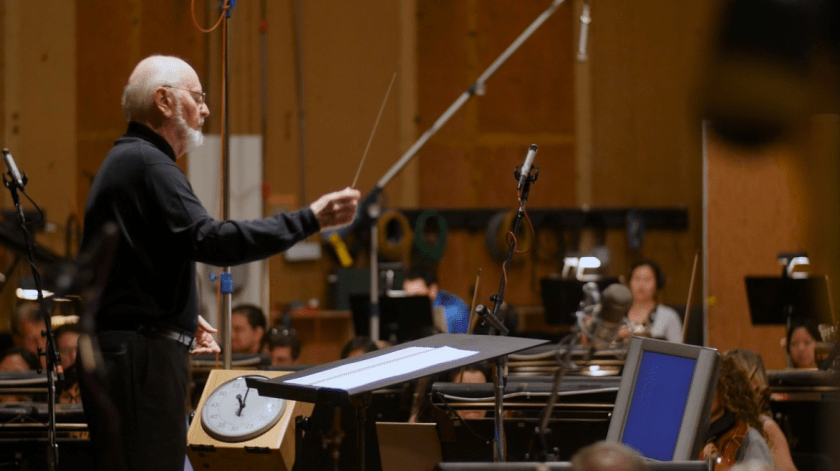
“Music by John Williams” is a nicely assembled documentary that celebrates of one of the most legendary composers in film history. Director Laurent Bouzereau not only honors Williams’ storied career, but also delves into his extraordinary talent, the depth of his musical knowledge, and the profound connection between sound and image that he masterfully weaves in his scores. It’s a puff piece to be sure, but it certainly is a blast to walk down memory lane with the man who is responsible for so many classic cinephile earworms.
The film does a fantastic job of highlighting the symbiotic professional relationship between Williams and longtime friend Steven Spielberg, a duo whose collaborations have resulted in some of cinema’s most magical moments. Through interviews with Spielberg, as well as other key figures in Hollywood (including George Lucas, J.J. Abrams, Kathleen Kennedy, James Mangold, and Ron Howard), the documentary paints a picture of a once-in-a-lifetime partnership that continues to thrive. Their mutual respect and friendship come across as genuine, and it’s clear that their collaboration is based not just on artistic synergy, but on a shared love for the craft of storytelling.
The film also touches on Williams’ wide-ranging understanding of musical styles, from classical orchestral works to jazz and funk, which he’s frequently infused into his scores. Clips of his iconic music paired with unforgettable film scenes from “Jaws” to “Star Wars” provide a thrilling reminder of just how much his work has shaped the way audiences experience movies. His orchestral compositions feel as timeless today as when they were first introduced, and the documentary underscores how Williams’ music can elevate even the most simple scenes into moments of pure cinematic joy.
One of the film’s most intriguing aspects is its focus on the process of scoring a film. Interviews with contemporary composers like Alan Silvestri, Thomas Newman, and David Newman offer fascinating insights into how Williams’ influence shaped their own work. Hearing from these composers really gave me a broader understanding of the art of film scoring and the reverence with which Williams is regarded in the industry. There’s a reason that he, at 92, is the living person with the most Oscar nominations in history with 54 (and five wins).
While the film celebrates Williams’ mastery of orchestral composition, it also explores his views on the evolving landscape of film music. Williams expresses concern about the rise of electronic scoring and laments that younger composers seem more interested in technology than in the rich, organic sounds of traditional orchestration. This sentiment underscores his belief that music, at its most powerful, should be created with real instruments, by real musicians. You can understand this position on a deeper level when the film takes a look at his career trajectory, from his beginnings as a jazz pianist to his rise as one of the most celebrated film composers of all time. Bouzereau touches on Williams’ early days and his innate passion for music, all which added up to a person making a living doing what they were obviously born to do.
“Music by John Williams” is going to be adored by anyone who loves movies and appreciates the value that original scores bring to the table. More than just a tribute, the film gives a detailed exploration of the man behind some of the most memorable movie music of all time, never losing sight of the sheer joy that Williams’ music continues to bring to audiences across the globe.
By: Louisa Moore
 Screen Zealots