
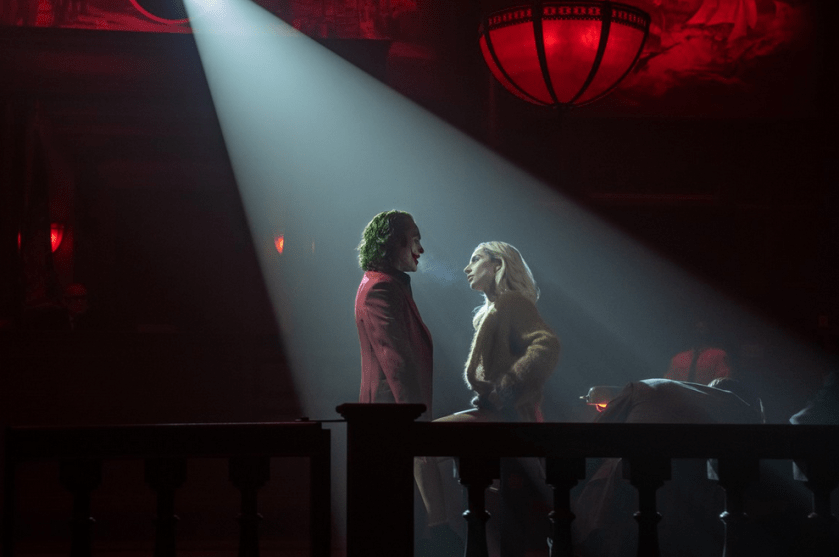
Director Todd Phillips dares to venture into the realm of bold artistic express with “Joker: Folie à Deux,” a spectacular misfire that squanders nearly every ounce of creative ambition. While the initial narrative starts off with a solid, compelling story, the shift into musical territory becomes its undoing. I’m not even sure you can say Phillips aims high with this one, but he certainly swings for the fences (and misses, repeatedly). Why anyone thought this would work as a musical is absolutely baffling, especially when your male lead actor can’t carry a tune.
The film opens with promise, showcasing Arthur Fleck (Joaquin Phoenix) as he awaits trial at Arkham State Hospital, a place for the criminally insane. Well known for his murderous crimes as alter-ego Joker, Arthur is abused mercilessly by prison guard Sullivan (Brendan Gleeson) but is somewhat popular with his fellow inmates. Heavily medicated and struggling with his dual identity, Arthur stumbles upon Lee Quinzel (Lady Gaga), a woman who just may be his true love. This awakens a joy inside him that makes him want to sing — literally.
Yeah, it’s bad.
Phillips struggles to give new meaning to classic standards like “Get Happy,” “World A String,” “That’s Entertainment,” and “If My Friends Could See Me Now,” and nothing sticks. It’s borderline embarrassing because you can feel the desperation in the effort being put out there as the film implodes in real time. There are clunky dance numbers that are awkward and poorly choreographed, and Phillips simply doesn’t know when enough is enough. Maybe one singing and dancing scene would’ve been okay (as a fantasy sequence, perhaps), but he pushes it on and on until it goes way too far and the musical numbers become irritating.
The saddest thing about all of this is that Phoenix’s performance will get lost in the shuffle (pun intended) come awards time, because nobody wants to give an acting trophy to someone in a bad movie. He embodies the complexities of Arthur’s dual identity with a raw intensity and physical commitment that makes it clear why he remains one of the greatest actors of our time. Phoenix commands the screen in every scene (where he’s not singing or dancing), and it’s disappointing to see such talent squandered in a film that fails to reach its potential. Lady Gaga, on the other hand, feels a lot like stunt casting. While she brings a certain charm to her portrayal of a DC fan-favorite, her performance feels overly self-aware and borders on self-indulgent. She’s a spotlight hog, and it feels like she is always trying to out-act Phoenix (who is an unmatched talent here).
At least the film is a visual feast, showcasing what Phillips does best: slick direction paired with striking cinematography (by Lawrence Sher). This is a great looking movie from top to bottom, but it’s unfortunate that the strongest elements can’t compensate for the overall train wreck.
The story ultimately meanders into a lackluster courtroom drama, so the first half hour stands out as the film’s most watchable segment. That’s what makes Phillips’ choice to turn this dark narrative into a musical experience feel even more misguided, because he detracts from the psychological intensity established in the film’s opening.
I guess you could say that I appreciate the audacity and creative vision on display in “Joker: Folie à Deux,” but it just doesn’t come together to make a very enjoyable movie. Overall it feels like a missed opportunity, a bold experiment that collapses under the weight of its own ambition.
By: Louisa Moore
 Screen Zealots