
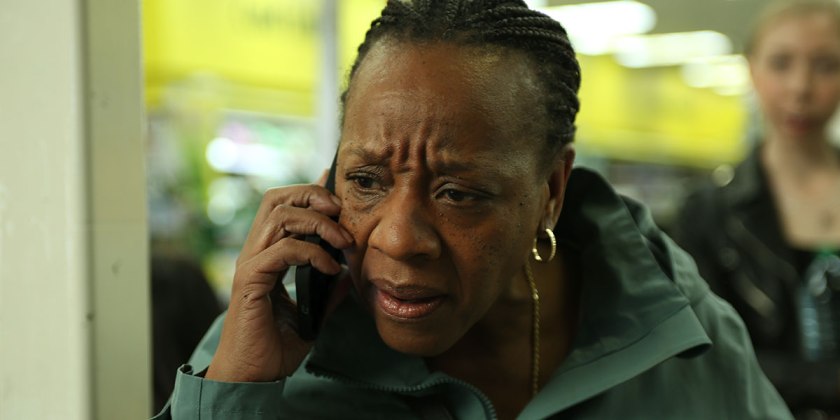
Writer / director Mike Leigh’s “Hard Truths” is a compelling exploration of family dynamics, social pressures, and the raw, often painful undercurrents of personal dissatisfaction. Known for his incisive character studies and realistic portrayals, Leigh delivers a film that is both bracingly tough and darkly humorous, wrapped in a layer of emotional complexity that hits hard.
The film follows the day to day routine of Pansy (Marianne Jean-Baptiste), a bitter woman who is angry with the entire world. Her constant indignation and relentless criticism of those around her, including her husband Curtley (David Webber), adult son Moses (Tuwaine Barrett), and friends and strangers that happen to cross her path, paint a portrait of a woman who is battling something deep within her soul. Unlikable and unpleasant, Pansy has a storm brewing inside her that’s caused by demons of the past and present.
This is a drama about family, and Leigh’s storytelling is methodical and organic. He lets his narrative unfold slowly, revealing the intricate layers of his characters. The film relies heavily on dialogue, yet it is in the silences and the unspoken that Leigh finds some of his most powerful moments. Pansy’s interactions are often punctuated by silence, and it is in these quiet, tension-filled moments that the weight of her regrets and unhappiness truly come to light. This approach underscores the film’s exploration of how people communicate — or fail to communicate — their emotions, particularly in a family where expression is stifled and misunderstandings abound.
Jean-Baptiste’s performance is absolutely riveting, capturing the essence of Pansy’s deep-seated loneliness and unfulfilled desires with unflinching authenticity. She is simply incredible here, and commands the screen with every scene.
The supporting cast is terrific too, adding layers of nuance to the narrative. Their characters’ reactions to Pansy’s outbursts range from resigned acceptance to silent suffering, painting a picture of a family struggling to cope with a loved one’s chronic disappointment, turmoil, and grief.
The film’s visual style, marked by its lack of a traditional soundtrack during pivotal scenes, enhances its raw and intimate feel. A seemingly mundane bouquet of store-bought flowers, for instance, becomes a symbol laden with emotional significance, reflecting Leigh’s ability to infuse ordinary objects with profound meaning. These small, symbolic details serve to enrich the film’s commentary on human connections and the need for understanding and compassion.
This isn’t an easy film to watch, however. It’s an experience that demands active engagement from its audience. The ambiguous ending, combined with the film’s reliance on silent and subtle cues, invites viewers to draw from their own life experiences to interpret the characters’ struggles and unresolved tensions. It is a testament to Leigh’s skill as a filmmaker that he can craft a story so deeply rooted in personal and familial discontent, yet leave space for viewers to grapple with its complexities and find their own reflections within its narrative.
“Hard Truths” is a quietly powerful film that delves into the human psyche with sensitivity and precision. This is a film that is both challenging and profoundly moving, a reminder of the very basic need for connection and understanding.
By: Louisa Moore
 Screen Zealots