
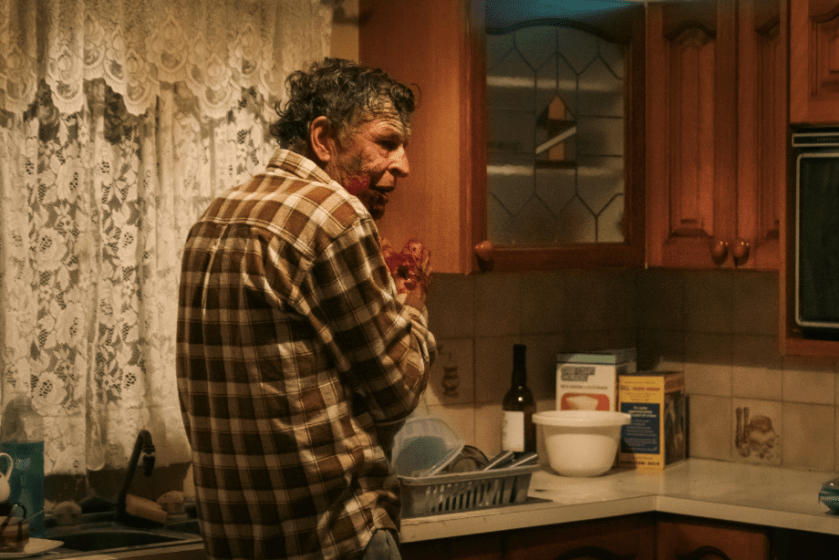
I loved the production values in “The Demon Disorder,” a brooding Australian demonic horror film that combines strong performances with an atmospheric setting to tell a supernatural tale of a dysfunctional family. Unfortunately, director Steven Boyle’s gross-out monster / body horror movie feels too familiar to make much of a lasting impression, and his heavy-handed use of symbolism and allegory for the destructive power of alcoholism is so over-the-top that it’s distracting. This film certainly is well-made, but isn’t one that’s enjoyably entertaining unless you’re a big fan of practical effects.
Haunted by his past, Graham (Christian Willis) lives alone in his garage workshop where he hides from the world. Out of the blue, he gets a surprise call from his bother Jake (Dirk Hunter), who is frantic. Apparently, their youngest brother Phillip (Charles Cottier) is possessed by their dead father, George (John Noble), who is hell-bent on revenge from beyond the grave. Jake begs Graham to come home to the family farm to help and when he does, the three brothers realize that the sins of their past can no longer remain buried.
The film’s greatest strength lies in its sense of place. The remote, rugged Australian landscape is beautifully captured, providing an eerie backdrop that enhances the story’s tension. The isolation of the setting mirrors the emotional and psychological isolation of the characters, particularly Graham, who has been haunted by his past since the death of their father and the estrangement from his two brothers.
The performances are solid across the board, with standout work from the lead actors. Willis is terrific as Graham, a man on the brink, struggling with the ghosts of his past and the weight of his family’s unresolved issues. The dynamic between the three brothers is believable and grounded, making their descent into horror all the more unsettling.
The impressive and well-executed practical effects bring the story’s more gruesome aspects to life. The creature design that represents the manifestation of the brothers’ deceased father is suitably grotesque, adding a visceral edge to the film’s horror elements. The blood and gore are used effectively, though some may find it veers into territory that feels overly familiar for the genre.
Where the film falters is in its narrative. Despite the strong setup and the film’s allegorical undertones, the story doesn’t offer much that hasn’t been seen before. The plot revolves around the brothers confronting a demonic force that embodies their father’s anger and alcoholism, which feels too much like a “been there, done that” scenario.
“The Demon Disorder” is a mixed bag. It’s a film with excellent performances, strong production values, and an evocative sense of place, but it’s ultimately let down by a story that doesn’t fully capitalize on its potential.
By: Louisa Moore
 Screen Zealots