
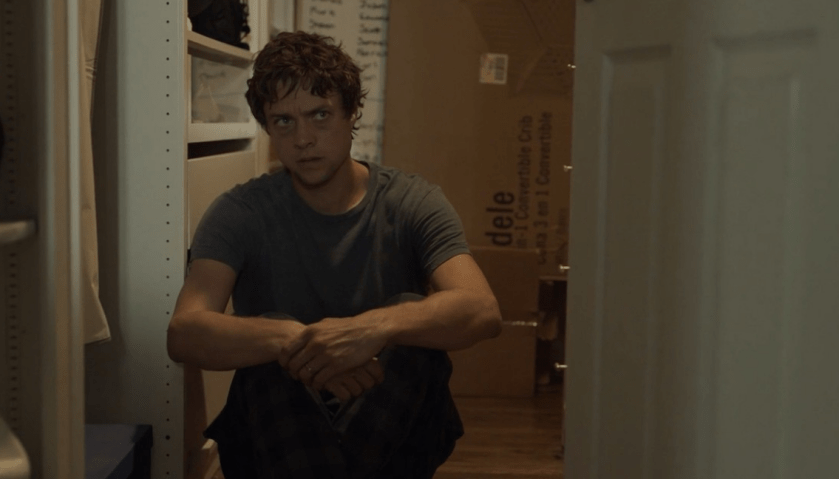
I can tepidly appreciate the experiment that is “Exposure,” a thriller that attempts to delve into the psychological horror of living with obsessive-compulsive disorder (OCD). But despite a promising premise, it falls short in execution. Director Peter Cannon seems preoccupied with making annoying artistic choices that veer towards experimental rather than effective, which causes the film to struggle to maintain a compelling narrative. All of this results in a viewing experience that is unnecessarily long and drawn out.
The film tells the story of Tanner (Douglas Smith), a man whose life has been upended by a traumatic kidnapping and poisoning years ago. The event left him with an overwhelming fear that his assailant is still out there, leading to compulsive behaviors that dominate nearly every aspect of his life. His wife Nicole (Margo Harshman) is patient and caring, but begins to worry when she finds out the man who did this to her husband is being let out of prison earlier than expected. This causes Tanner to spin out of control, giving Nicole the idea to send him to exposure therapy so he can face his fears head-on.
Smith’s performance comes across as amateurish, failing to fully convey the deep psychological torment his character is supposed to be experiencing. His portrayal lacks the nuance needed to draw viewers into his character’s turmoil, making it difficult to fully invest in the journey.
The film’s hook is intriguing at first, especially watching Tanner obsessively avoiding consuming anything that isn’t factory-sealed. The problem is that these small hints about the man’s mental disorder aren’t enough to speed up the pace of the slowly unraveling mystery. You’d think as Tanner’s obsession escalates, the story would build tension. Instead, it becomes repetitive and predictable.
Cannon’s artistic choices are likely intended to create a sense of unease and disorientation, but they often feel forced and distracting. The film’s visual style is occasionally striking but doesn’t mesh well with the story. The long, drawn out scenes further dilute any hope at tension or suspense, and what could have been a gripping psychological thriller is instead a sluggish narrative that never quite finds its footing.
By: Louisa Moore
 Screen Zealots