
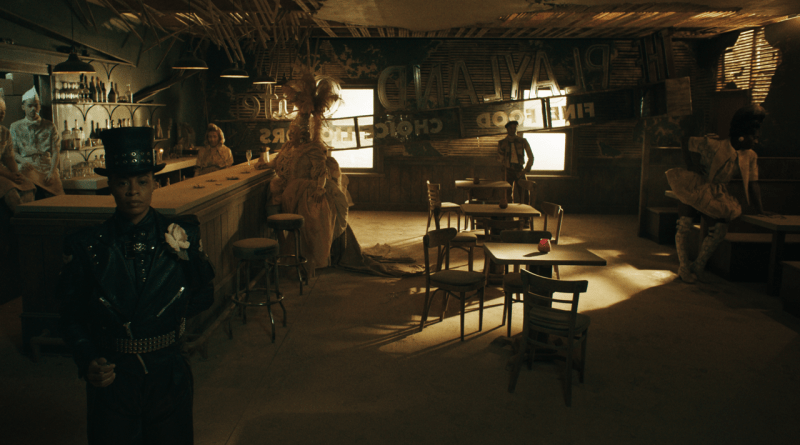
There is no way, in good conscience, that I can recommend writer-director Georden West‘s high-concept queer historical fantasy “Playland” to mainstream audiences. As much as I want to love the project, I cannot endorse it for even the most sophisticated, art loving audiences either. While I appreciate the risky avant-garde storytelling style and the boundary-pushing qualities, this excruciatingly slow film is exhausting, exasperating, and an absolute chore to sit through.
In what presents as an off-Broadway play at a hipster experimental theater, the film is a hybrid of fact and fiction about Boston’s oldest and most notorious gay bar, the Playland Café. Set over one night, the narrative jumps through time with story lines set in 1943, 1965, 1977, and 1992, reuniting barflies of the past in a venue that shut its doors before Y2K.
The cast (The Lady Bunny, Danielle Cooper, Mason Caminiti) is composed of a mix of disco divas, drag queens, and more, all who create a larger than life presence within the imagined story, and the film is all about celebrating diversity and uniqueness. West has an eccentric vision that’s fully realized in a film that is nothing if not a highly personal expression of an artist and his artistic style. By using archival footage both audio and visual, West incorporates dramatic vignettes to accompany the powerful words spoken by real-life customers of the bar. It’s a bold piece of performance art that’s woven with the sound of unique voices, which works together to re-create an imagined (yet still real) gay history.
I’m in awe of the concept of the film and its interesting style and subject matter, but “Playland” isn’t something that is fun to watch, and it’s certainly not a film I ever want to see again. A project like this belongs somewhere it would be right at home: in a modern art museum, playing on a continuous loop.
By: Louisa Moore
 Screen Zealots