
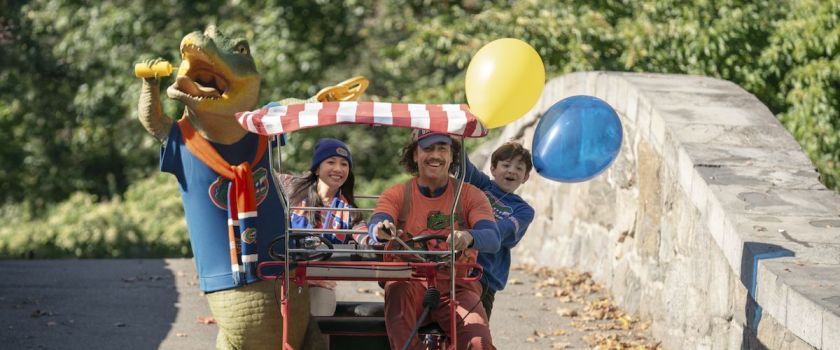
The live action / computer animated movie “Lyle, Lyle, Crocodile,” based on Bernard Waber’s beloved children’s books, isn’t the most original story in the world. It has a premise that’s not easy to accept, but it’s a fantasy tale with a whole lot of heart. This sweet, all-ages film is packed with catchy original music, dance numbers, and a singing crocodile who teaches one family about love, facing fears, and being true to yourself.
When the Primm family, including dad (Scoot McNairy) and stepmom (Constance Wu), moves to New York City, their son Josh (Winslow Fegley) struggles to adapt to his new normal. He isn’t fitting in at school and is finding it difficult to make friends. All of that changes when Josh discovers Lyle (voice of Shawn Mendes), a scarf-wearing, singing crocodile, who lives in their attic. Lyle doesn’t talk but can communicate verbally through song, and he loves music. Josh and Lyle become best friends and grow close quickly, especially when the nasty downstairs neighbor Mr. Grumps (Brett Gelman) becomes suspicious of the strange shenanigans going on in the flat above and wants to evict the family. Things get more complicated with Lyle’s original owner, the struggling showman and magician Hector P. Valenti (Javier Bardem), returns after several years and wants to use his reptile friend as a cash cow.
It’s a silly story that requires a great deal of suspension of disbelief, but almost everything about the film is charming. The cast is terrific, and Lyle is animated in an approachable way that makes the fact that he could be a man-eating crocodile a lot less scary. He has a huge personality that’s sunny and infectious. When paired with toe-tapping songs by Benj Pasek and Justin Paul (the duo responsible for the terrific tunes from “Dear Evan Hansen,” “La La Land,” and “The Greatest Showman”), the film becomes a good-natured spectacle that’s hard not to like.
Will Davies’ adapted screenplay updates some of the story to better address modern-day problems and situations (the original book was published in 1965, after all) and doesn’t veer totally off the rails (with the exception of a rapping rattlesnake, I didn’t once groan or roll my eyes). Davies keeps the story simple and easy to follow, even for the youngest moviegoers.
Featuring diverse representation and positive messages about courage, honesty, teamwork, and friendship, “Lyle, Lyle, Crocodile” is a family-friendly adventure that provides a lot of good-natured fun.
By: Louisa Moore
 Screen Zealots
Adaptations of beloved children’s books to film can often walk a precarious tightrope between capturing the essence of the original story and introducing elements that enhance the cinematic experience. However, in the case of “Lyle, Lyle, Crocodile,” the transition from page to screen appears to have stumbled, leaving behind a trail of disappointment and dissatisfaction.
One of the primary critiques leveled against the movie adaptation of “Lyle, Lyle, Crocodile” is its perceived dullness. The essence of Bernard Waber’s charming tale about a crocodile named Lyle who lives with the Primm family on East 88th Street in New York City seems lost in translation. The vibrancy and whimsy that characterize the original book appear muted and lackluster on screen. Viewers expecting the magic of childhood wonder and the endearing adventures of Lyle may find themselves instead confronted with a lack of engagement and excitement.
Central to the disappointment are the songs featured in the film, which are described as “trash” by some critics. Songs in children’s movies play a pivotal role in shaping the narrative, engaging young audiences, and conveying the emotions and themes of the story. When executed poorly, they can detract from the overall experience and fail to resonate with viewers. In the case of “Lyle, Lyle, Crocodile,” the songs not only fail to capture the essence of the original narrative but also fail to create a meaningful connection with the audience. They may come across as contrived, uninspired, or simply out of sync with the tone and spirit of the story.
Moreover, the disappointment extends beyond the songs themselves to the broader execution of the movie. The pacing may feel sluggish, the characters less dynamic than their literary counterparts, and the visual representation of East 88th Street and its inhabitants may lack the charm and authenticity that readers imagined while flipping through the pages of Waber’s book. Such shortcomings can further contribute to a sense of disconnect and disenchantment among both young viewers and their accompanying adults.
In conclusion, while “Lyle, Lyle, Crocodile” may have endeavored to bring a beloved children’s book to life on the silver screen, the execution appears to have fallen short of expectations. The movie’s perceived dullness and disappointing songs underscore the challenges of adapting cherished literature for a visual medium. Ultimately, the success of such adaptations hinges not only on fidelity to the source material but also on the ability to capture its magic and translate it into a compelling cinematic experience that resonates with audiences of all ages. Sure the characters were cute but the plot wasn’t enough for me.
LikeLike